

Tell us a little about yourself and the monkey’s paw Bookstore.
SF: The Monkey’s Paw is a small antiquarian shop, specializing in old and unusual printed matter (books and ephemera). Most of our stock was printed in the mid-20th century, and some is even older; we don’t carry anything printed in the digital age.
As for subjects and genres, we emphasize visual culture; obsolete opinions and technologies; earnest works on highly specific topics; books as artifacts; and pop detritus. Our literature section is not large, but is carefully chosen.
Why did you decide to open a bookstore?
SF: I opened the Monkey’s Paw in Toronto in 2006. At the time, many secondhand bookshops around the world were closing, or migrating to an online-only model; so it seemed like a perversely good moment to offer a physical space where people could browse and interact with old books. Also, I had worked at many secondhand bookshops in my youth, and buying and selling old books was pretty much my only marketable skill.
What kind of reading trends do you see with your customers?
SF: Our stock is so diverse and eccentric that it would be hard to identify “trends” among our customers. But some of the genres that sell especially well here are nature field guides; type specimen books; regional and ethnic cookbooks; smut novels; illustrated collections of folktales; arcane technical and how-to manuals; works of radical politics… among many other niche topics.
What other services and/or products do you provide for your customers? what makes your store stand out?
SF: For people interested in discovering old books they never knew existed, the Monkey’s Paw offers a comfortable, well-organized space to browse. I like to think the shop is a bit like a museum of 20th century culture, where you can handle the artifacts, and (if you wish) purchase them.
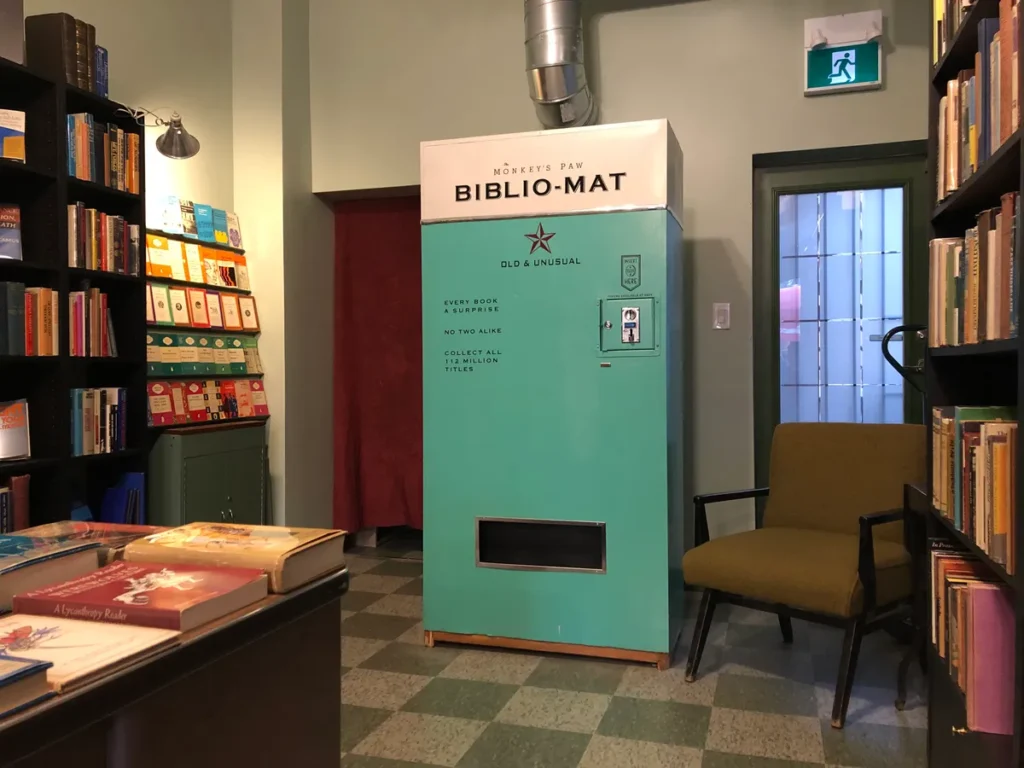
For customers without the time or patience to make their own discoveries, we have a vending machine (the “Biblio-Mat”) that sells random/surprise old books for a $5 token. The Biblio-Mat adds a slightly carnivalesque flair to the place.
How do you see the monkey’s paw expanding in the next few years?
SF: As it is, the Monkey’s Paw already occupies every minute of my time, so I have no plans for expansion. If I can continue to find old books that meet the shop’s criteria, in sufficient quantity to supply the demand, I will be satisfied.
What do you think the future of indie bookstores looks like?
SF: I don’t know anything about the new book business, and wouldn’t want to hazard a guess about its future. But as far as old books are concerned: it’s my understanding that in recent years more small secondhand/antiquarian shops have opened in various cities, following something akin to the Monkey’s Paw model.
I would say that our stability over the last two decades proves that a shop like ours — in the right urban setting — is a feasible business. Nobody’s getting rich here, but we’re sating the appetites of a good number of curious bibliophiles. Doesn’t every city deserve a place like that?
Continue Reading
Article originally Published in the Fall 2026 Issue