
Translator of The Depopulation
By Sarah Kloth

The History Behind The Novel
The Depopulation is set in the 1600s, in a region caught between Spanish and Portuguese colonial rule, during a period when raiders marauded through the area — an episode that saw tens of thousands of Guaraní people killed or driven from their homes, including many living around the Jesuit mission where the novel begins.
This story is rooted in a real and pretty brutal chapter of South American history. How much digging into that history did you have to do before you felt ready to translate the book?
TB: I dug a little and already knew a little about the period, but as a translator, I tend to think that the original itself should and must and basically will contain all I need to know. I’m trying to recreate my own experience of the original, and given that I loved the book, more than anything it’s about trying to bring that love and enthusiasm to bear.
Two of the main characters, Father Ruiz and Father Maceta, are based on real Jesuit priests. How did you approach translating real historical figures turned into characters, while still keeping them feeling like flesh-and-blood people rather than just names from a history book?
TB: Again, the original told me pretty much all I needed to know, but that said, it was useful to know a bit about Marina Closs’s writing process. She sent me some of the works that drew her into the subject and from which she’d lifted ideas and phrases. One was by a Catalan anthropologist and priest that contained an interpretation of the Guaraní worldview and their concept of the “soul/word,” and the other, by an anthropologist from Paraguay, was a transcription and Spanish translation of sacred Guaraní texts. These are of course records of colonialism in action, and the partial, flattening nature of the priests’ interpretations—which are nonetheless entirely in earnest—is clearly key to the bizarre yet recognizable world into which Closs take us.
One character claims to be the son of God, and another believes she used to be a plant — and the book treats this completely matter-of-factly. How did you find the right tone in English so readers just go along with it, the way you did?
TB: As always in a translation, just about every sentence and clause potentially contains a fork in the translator’s path. With a very “voicey” book like this one, where there’s a lot going on in the space between what the narrator knows and is able or willing to reveal, and what we know, and what the characters know, I certainly found myself attending to small technical things at a sentence level—a different approach to contractions, for instance, than one would take with a modern-day voice, to give a concrete example (it’s difficult to talk usefully about translation in the abstract…). Still this was really about following the Spanish, which in its own way transports us into a historical moment while avoiding obvious egads!-ye olde-Monty Python-isms.
Carrying the Story Into English
This is Marina Closs’s English-language debut. The novel moves between a narrator, diary entries from Father Ruiz, and passages that read almost like a chorus of Guaraní voices.
What made you want to be the one to bring Marina’s voice into English?
TB: It’s rare to come across books that feel both zany and urgent. There’s a sort of enthused, wide-eyed nihilism to the world Closs creates. The depiction of Fathers Ruiz and Maceta—and how recognizably, transhistorically human she makes them—seems like a clear decision: by bringing their world so messily and disconcertingly to life, she takes us inside what is troubling about colonial projects far more effectively than straight history or indeed straight lambasting satire.
Were there specific words or ideas — religious terms, or things tied to that time period — that were especially hard to translate?
TB: The original novel is in Spanish, but contains some Guaraní terms, which it felt important to retain, glossing in certain instances, but always trying to get across the strangeness of the world for the Spanish outsiders and the impossibility of fully putting it inside their Catholic-Old World box. And there’s also this clash/interface with the Portuguese language spoken by the marauding Mestiços (as I decided to term them). This was a balancing act, and doubtless another translator would have approached it differently. The Portuguese I had to think about; which language is proximate to English in the way Portuguese is proximate to Spanish? I mean, which language would an English speaker hear and, presuming they weren’t a linguist and couldn’t lean on Latin or Greek or anything, still partly understand? In The Depopulation, there are crucial scenes late in the book when Portuguese-speaking characters appear, and the Spanish-speakers can mostly understand what they are saying, but are also flummoxed and have to kind of make it up—how to get that across? Footnotes were also out-of-the-question for me. It basically took a bit of license, and a little more explanation and in-line decoding than Spanish readers would obviously need, to try to ensure those moments would land.
How involved was Marina in the translation process, if at all?
TB: She was involved, thankfully. One of the interesting discussions we had concerned the mechanics of a catapult that features towards the end of the book! It’s fashioned from a kind of bamboo that grows in the jungle, and shoots these little mud-and-stone projectiles. I needed to ask lots of question so I could get a full picture of the contraption and be sure to supply the right verbs and so on when it’s wheeled into place and the projectiles loosed. Things like that.
Closs’s Rising Career — and What Drew You In
Closs has already won and been shortlisted for some major literary prizes, and her writing has drawn comparisons to acclaimed authors like Guadalupe Nettel and Samanta Schweblin.
Where do you see this book fitting in alongside those comparisons?
TB: I’m not sure the similarities should be overstated, though they’re certainly all electrifying writers. Perhaps in Closs’s other works, which have yet to be published in English – Tres Truenos, Pombero, La encendida silenciosa – the concerns with Schweblin’s Distancia de rescate/ Fever Dream are a bit clearer than in a historical fiction like The Depoulation. An interest in the uncanny/ numinous, a neo-fabular/fantastical tinge (nobody say magical realism, please), a psychological acuteness, an ethical probing, a clear feminist edge… But each are quite different writers, really.
You’ve compared what Closs is doing here to what Hilary Mantel did with Thomas Cromwell — telling a familiar kind of story in a way that upends what people think they already know. What do you think this book gets readers to see differently about this period of history?
TB: I think I meant more in terms of the voice than any ripping-up of received historical opinion. Closs is clearly bringing this slanted historical tone, both arrestingly and weirdly “historical” and somehow modern, that powerfully inserts us into the world. Whenever I look at those books by Mantel, it’s the voice above all I’m astonished by. My guess is that it must have involved Mantel immersing herself in voices contemporary with Thomas Cromwell, and writing “out of” that place.
You’ve said this book affected you in a way that realist novels usually don’t, and that it convinced you Closs has real greatness in her. What was it about this particular book that got to you like that?
TB: It did something to me bodily, the way great books do. There is an undertow of hilarity to the encounter between the priests and Overá in particular, and in turn between those three and certain longsuffering female characters, but none of it is played for laughs; the Spanish priests are of course horrendous colonial cyphers, yet Closs brings us inside their wholly earnest attempts to do what they’re there to do—save poor benighted souls! It’s highwire stuff.
What do you want readers coming to Marina’s work for the first time to know before they start?
TB: That this is only the beginning—she is quite prodigious!
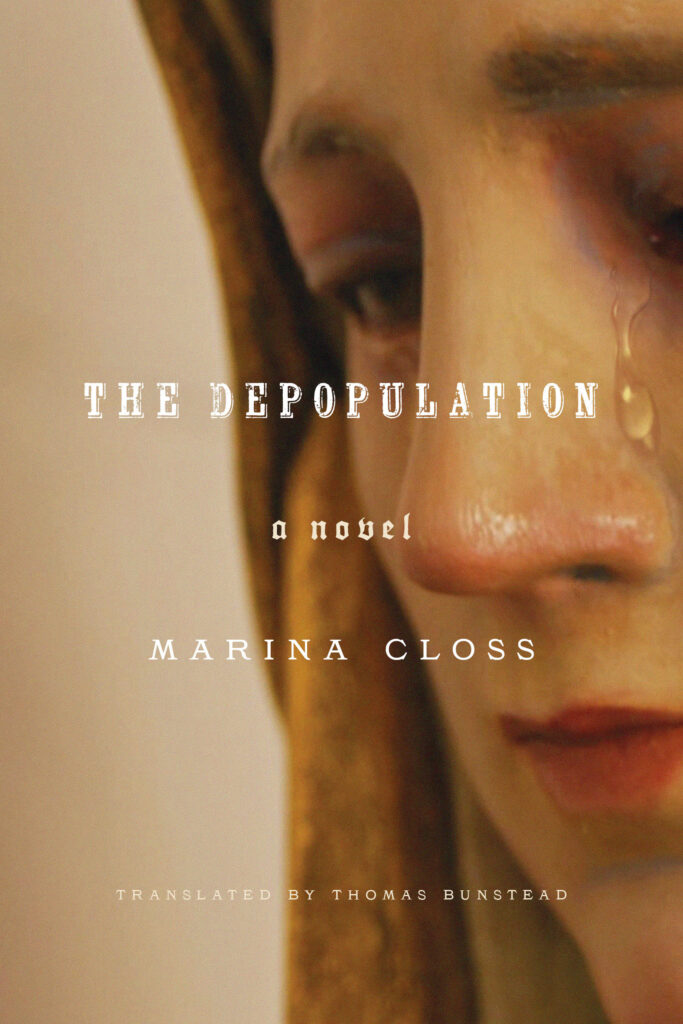
The Depopulation
By Marina Closs
Translated by Thomas Bunstead
“Of all the happy, hermitic lands, the Guayrá was the jewel.”
So begins this polyphonic wonder of a novel set in a 17th-century Jesuit mission founded within the wild South American subtropics by the mystical and intense Father Ruiz and his assistant Father Maceta. As the priests seek to convert the indigenous Guaraní and unravel the many religious mysteries that surround them, the harmony of their community is abruptly upended by the arrival of Overá, who announces himself as the Son of God and younger brother of Jesus. But an even larger threat presents itself when word arrives that European marauders and slave hunters will soon descend upon the peaceful mission, compelling Overá and the priests to launch a mass exodus into the heart of the jungle.
Full of humor, passion, and terror, The Depopulation (Bellevue Literary Press) brilliantly evokes the moment when modernity’s spark set fire to a still-magic world.
Continue Reading…
Article originally Published in the Fall 2026 Issue.