
Author and Translator of Murder at the End of the World
By Sarah Kloth

Author Bio:
Akane Araki was born in 1998 in Fukuoka, Japan. She is a graduate of Kyushu University’s School of Letters. Murder at the End of the World is her first novel, and it won the prestigious Edogawa Rampo Prize.
Translator Bio:
Jesse Kirkwood is a literary translator working from Japanese into English. The recipient of the 2020 Harvill Secker Young Translators’ Prize, his translations include The Kamogawa Food Detectives by Hisashi Kashiwai, Tokyo Express by Seicho Matsumoto and The Man Who Died Seven Times by Yasuhiko Nishizawa (available from Pushkin Vertigo).
Where the Story Began.
Before Murder at the End of the World existed in English, it was Akane’s prize-winning debut — a serial killer story that set out to do something different with a familiar genre.
Murder at the End of the World is your prize-winning debut. What first inspired the story, and what did it mean to have it recognized with the Edogawa Rampo Prize?
AA: The starting point for the novel wasn’t actually the idea of an asteroid striking Earth. Just before graduating from university, I started attending driving school, and that was where the initial inspiration came from. I have poor coordination and I’m also quite timid, so I found the lessons really hard. I was really miserable there, and to take my mind off it I started imagining a novel set at a driving school. Before long, I’d decided I wanted to write a mystery featuring an instructor and a student as an investigative duo. But I couldn’t think of a plausible situation where you’d have two ordinary civilians taking the lead in an investigation instead of the police, so I ended up creating a dystopian setting in which the police had been severely incapacitated.
When I was writing the book, my biggest ambition in life was to win the Edogawa Rampo Prize. It’s a highly prestigious award with a long history, and its previous winners and judges are all leading figures in the field. So from the age of fifteen, when I first started writing mysteries, I’d dreamed of having the title ‘Edogawa Rampo Prize winner’ attached to my name. It’s been four years since I won, but even now it doesn’t quite feel real.
The novel has been described as a serial killer story “with a difference.” What did you want to do differently within that genre?
AA: The various ingredients of the novel are not especially new in themselves, but by combining them in my own way I hoped to create something that would read differently from the serial-killer novels that had come before. In particular, two key aspects of the novel feel fresh to me: it’s a female buddy story, and a ‘road novel’ set in a regional city.
Many of the settings in the book come from the area where I was born and brought up, but it isn’t the kind of place you’d ordinarily expect to see depicted in a novel or television drama. To people living in big cities like Tokyo, Kyushu is a distant and little-known part of the country – and young women who choose to stay and make their lives in those sorts of provincial areas also tend to be overlooked. So I thought that if I could combine the everyday scenery I knew so well with a mystery story, I might be able to create a world that would feel unfamiliar to lots of readers in different ways.
How did you think about tone, suspense, and misdirection as you built the story?
AA: The story takes place with the end of humanity fast approaching, but I deliberately tried to avoid making the overall tone too bleak. I was interested in portraying the ordinary routines that return after people have come to terms with tragedy or simply resigned themselves to it, which is why the protagonist’s narrative voice is so matter-of-fact.
Another feature of the novel is that almost every scene is presented from the protagonist’s first-person point of view, which allows me to control how much information is given to the reader. By only gradually disclosing key information – while intentionally concealing other things – I tried to enable readers to experience the suspense of the story from the same perspective as the protagonist.
What first drew you to Akane’s writing, and what made this novel feel like the right project to bring into English?
JK: The novel had been on my radar after winning the prestigious Edogawa Rampo Prize, but my curiosity was really piqued when I learned it was set in Dazaifu in Kyushu, where I spent my first year in Japan, back in 2012. The idea of revisiting a part of the country that holds so many memories for me – this time refracted through Araki’s striking apocalyptic vision – was irresistible, as was the chance to spend time with such convincing and sensitively drawn female protagonists, who remain all too rare in crime fiction. So when Pushkin approached me to translate the novel, I was all ears.
This is Araki’s prize-winning debut. How did you approach translating a brand-new voice, especially within a genre like crime fiction that has such particular conventions?
JK: Araki writes in such a fresh and winning style, and I wanted to stay true to that as much as possible. Even the parts of the book that hew more closely to traditional crime fiction are filtered through the perspectives of Haru and Isagawa, so the central challenge was ensuring that both characters (and their distinct voices) came fully alive in English. Much of that comes down to word choice, especially in dialogue where tiny adjustments can really pull the voice in whatever direction it needs to go – playful, stern, hesitant and so on.
JApanese crime fiction often plays with structure and perspective in ways that don’t map neatly onto English. Were there structural or stylistic choices in the original that required creative solutions?
JK: Yes – although explaining them properly would require a short essay and also several spoiler warnings! The novel’s structure is closely bound up with its revelations, so some of the trickiest decisions involved controlling exactly when information becomes clear in English. Japanese can leave certain things unstated in ways that English often resists; the challenge is often to preserve that uncertainty without making the prose feel evasive.
Were there specific words, idioms, or cultural references in the book that posed a particular challenge to translate?
JK: The relationship between Haru and Isagawa is central to the novel, and it rests on the teacher-pupil dynamic set up by the fact that Isagawa is technically her driving instructor. Even as they end up solving a murder together, that dynamic never goes away, and in Japanese it’s constantly reinforced by Haru addressing Isagawa as sensei. If you retain the Japanese word every time, it begins to feel intrusive in English, but remove it and you lose something essential to their relationship. I ended up keeping only the instances where it carries an emotional weight that felt important to the scene.
How closely did you work with Akane during the translation process, if at all?
JK: Authors tend to be very busy people, and I also feel that a translation needs room of its own to breathe. So I tend to save direct queries until fairly late in the game, when it’s become clear that the author’s input is really vital. In this case we floated a slightly wild workaround for one particular problem, and Araki (probably wisely) asked us to rethink it.
As a translator working from Japanese into English, how do you think about your own voice versus preserving the author’s?
JK: My job is to try to recreate, using the tools available to me in English, whatever feels most unique or striking about the author’s voice and the experience of reading the novel. Insofar as I have my own ‘voice’ in translation, I think it consists in the choices I make as I go about that process.
What has it been like seeing the novel reach English-language readers for the first time, through Jesse’s translation?
AA:I’m delighted and amazed that, through Jesse’s translation, this novel has travelled to places I could never have reached on my own. When I wrote it, I wasn’t even a professional writer, and I couldn’t even imagine people reading it in Japan, let alone in the English-speaking world, so I still find all of this hard to believe.
Given the cultural differences involved, I was initially worried about whether readers in the English-speaking world would connect with the novel. I found myself wondering whether such readers could really enjoy a novel containing so many scenes rooted in Japan’s specific driving-licence system and set in such a specifically local part of Fukuoka. If the novel’s qualities have come across, that’s entirely down to Jesse’s sensitive and skilful translation.
What was the most satisfying moment you had while translating this novel?
JK: Whenever the novel took me somewhere I recognized from my time in the area: mountains I’d climbed, stations where I used to catch the train. I once ate the best oysters of my life in a hut very similar to the one where a key scene in the novel takes place. I’m not sure how much of that familiarity made its way into the final manuscript, but it definitely gave me a very vivid sense of the landscape as I translated.
What do you hope readers — in Japan and abroad — take away from this book?
AA: Throughout the novel, there are scenes where the characters find their moral compass being shaken. If the world’s about to end, why not just do whatever you want? If everyone’s doomed anyway, what does it matter if you end up hurting other someone else? At the same time, the novel asks whether there are certain values we should never lose sight of, no matter how extreme our circumstances become. Our world is held together by the trust we place in other people. I’d be very happy if everyone who reads this story comes away convinced of that.
What do you want new readers to know about you as a debut voice in Japanese crime fiction?
AA: There are times when I think I’d rather people knew nothing about me. In the novel, Haru, is patronized by being called ‘young lady’, and I often feel like something similar happens to my work once readers know it was written by a relatively young woman. Even though I’m approaching thirty now, I still often hear people say how surprising it is that a ‘such a young, quiet-looking woman’ could write this novel. Whenever that happens, I want to say: forget about me – just read the novel.
At the same time, I also feel very strongly that I want readers to know about my background. It’s a very ordinary and maybe quite a dull background, but I think there may be people who would find that encouraging. I was born and raised in one of the more rural parts of Fukuoka, far from Japan’s major cities. I’ve never lasted long in an office job, I’m not very good with people, and the only qualification I have to my name is a driving license. I’m a twenty-eight-year-old woman, and I love nothing more than reading and writing detective stories and crime fiction.
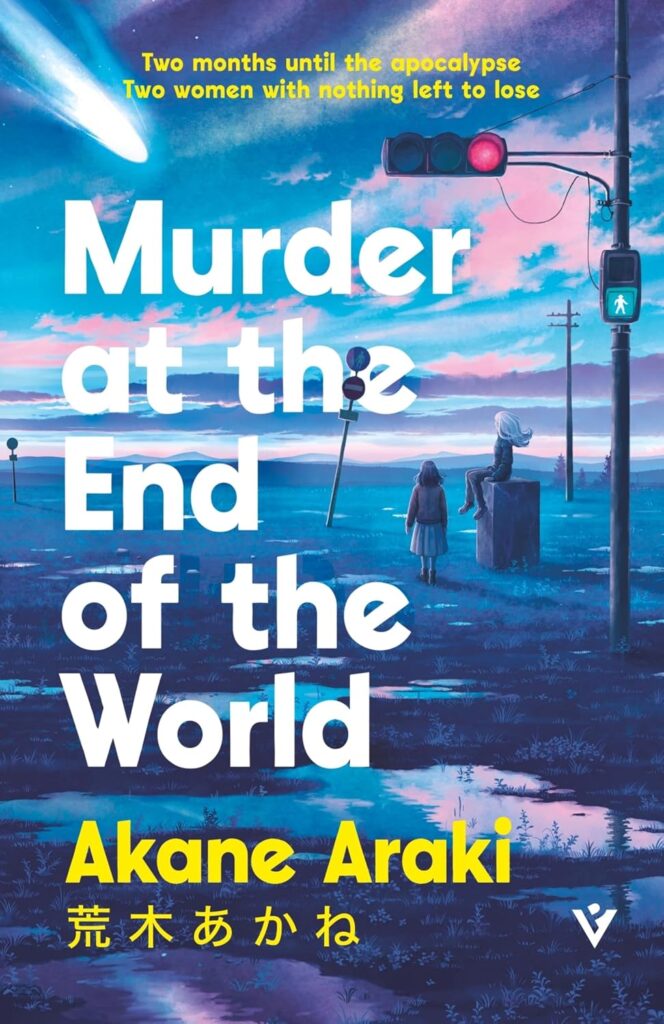
Murder At The End Of The World
By Akane Araki, translated by Jesse Kirkwood
An asteroid is hurtling towards Earth and the human race has just over two months to live. But twenty-three-year-old Haru, stargazer and chronic worrier, is still trying to pass her driving test.
Then she finds a body in the boot of her car: a woman, stabbed and tortured. There’s a murderer on the loose. And it turns out that Haru’s driving instructor is an ex-cop with a manic devotion to justice. So, despite the small matter of an impending apocalypse, the two women team up to catch the culprit regardless of the danger.
After all, the world’s not quite over yet…

Continue Reading…
Article originally Published in the Fall 2026 Issue.