
Review by Sarah Kloth
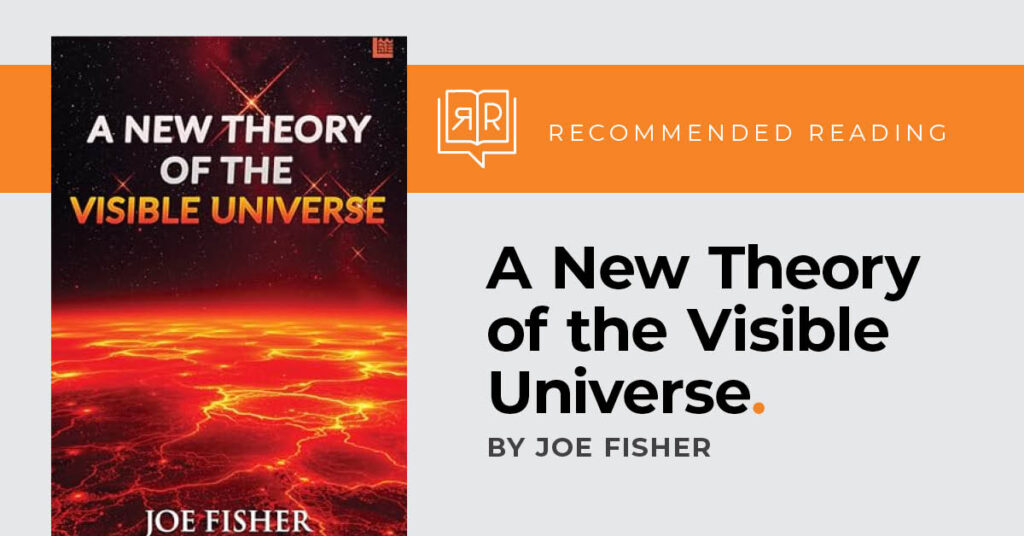
A 90-Year-Old Takes On Einstein — And Writes One of the Most Surprising Books of the Year
Some books quietly ask for your attention. A New Theory of the Visible Universe walks right up and grabs it.
Joe Fisher is 90 years old. He is a retired gas-company clerk who never finished high school. He grew up in Manchester, England, has supported the Manchester City football club his whole life, and now lives in North Carolina. At an age when most people are slowing down, he has done the opposite. He has written a book that takes on three of the most famous names in modern science: Einstein, Hubble, and Hawking. And the result is one of the most surprising and enjoyable books I have read in a long time.
His main idea is simple. Joe thinks modern science has built its whole picture of the universe on things we cannot actually see — invisible atoms, invisible particles, invisible gravity, and a Big Bang explosion that supposedly happened billions of years ago but that no one was around to watch. To Joe, that sounds less like science and more like faith. His answer is much simpler. The universe, he says, is exactly what we can see. One huge, never-ending, visible surface, lit by light. That is it. No empty space. No Big Bang. No expanding universe.
You can agree with him or not. That is not really the point. The point is the way Joe writes. He sounds like a sharp older man talking at the kitchen table — funny, blunt, and full of mischief. He takes Einstein’s most famous thought experiments and adds the word “imaginary” in front of every key word, just to show you how much of the argument depends on things no one ever saw. He prints his own rejection letters from science journals right inside the book. He dedicates the whole thing to his old coworkers at the Brooklyn Union Gas Company in New York. He even has a chapter titled “Why Am I Not Famous?” — and yes, he is actually asking.
The book is made up of 11 chapters, most of them based on essays Joe has been writing for years and entering into a science essay contest. He has been quietly publishing for over a decade, with no fancy degrees to his name. Chapters like “Hubble Trouble” and “Space Out” lay out his main arguments. “Why Am I Not Famous?” is the funniest. But the part that will stay with most readers is the very last section, the Afterword, titled “Why Did the Popes Believe Stephen Hawking?” In it, Joe drops the jokes for a moment and admits he is deep in debt and hoping the book might finally bring in enough money to help. It is honest and a little heartbreaking, and it gives the book a weight you do not expect from the funny pages that came before.
To be clear, this is not a science textbook. If you are looking for hard physics with equations and footnotes, this is not the book for you. But that is not what Joe is trying to write. This is one man’s personal argument — passionate, stubborn, and very much his own. It belongs on the shelf next to other books written by self-taught thinkers who decided the experts did not have everything figured out.
What sticks with you in the end is not really the science. It is Joe himself. A working-class kid from Manchester who built his whole intellectual life on his own, with help from the public library and the internet, and a stubborn refusal to be told what to think. The book is a delight because it does not follow the rules. It is funny, sharp, sometimes repeats itself the way older folks do when they are really trying to make a point, and quietly moving when you least expect it.
I will say it plainly: I do not agree with Joe on much. Not his takes on science, and not his takes on religion. He is a sharp skeptic of pretty much everything, and along the way he picks a few fights I would not have picked. But the joy of this book is not in agreeing with Joe. It is in meeting him.
Recommended for: readers who love books by self-taught thinkers, fans of popular science who want a different angle, anyone who enjoys a sharp older voice with something to say, and anyone who has ever suspected that the smartest person in the room might not have the fanciest degrees.
The bottom line: A bold, funny, one-of-a-kind little book about how one self-taught man sees the world after 90 years of looking. I did not agree with much of it. I liked the man behind it all the same.
About the Book

A New Theory of the Visible Universe.
For over a century, physicists have upheld the belief that the universe consists of both matter and space — two fundamental components of existence. In A NEW THEORY OF THE VISIBLE UNIVERSE, Joe Fisher boldly challenges this long-standing assumption, proposing a revolutionary vision of reality: there has never been any “space.” Instead, there has only ever been one infinite, visible, contrasting surface — eternal, seamless, and continuously illuminated by an infinite form of finite non-surface light.
Fisher’s radical reasoning dismantles the core principles of modern astrophysics. He asserts that the universe cannot expand, that Einstein’s curved space-time is imaginary, and that Edwin Hubble’s observations were misinterpreted. The Big Bang, Fisher argues, was an illusion — for an infinite universe could never have a beginning, an end, nor a period of cooling. Infinity does not explode; it endures.
In this groundbreaking study, Fisher refutes the work of Einstein, Hubble, and Hawking, as well as the theories endorsed by NASA, Roscosmos, and the China National Space Administration. Written with clarity, conviction, and the rare courage to question scientific orthodoxy, A NEW THEORY OF THE VISIBLE UNIVERSE invites readers to reexamine everything they believe about existence itself.
This is not just a book about physics — it is a call to see the universe as it truly appears: infinite, visible, and forever alive in contrast.