
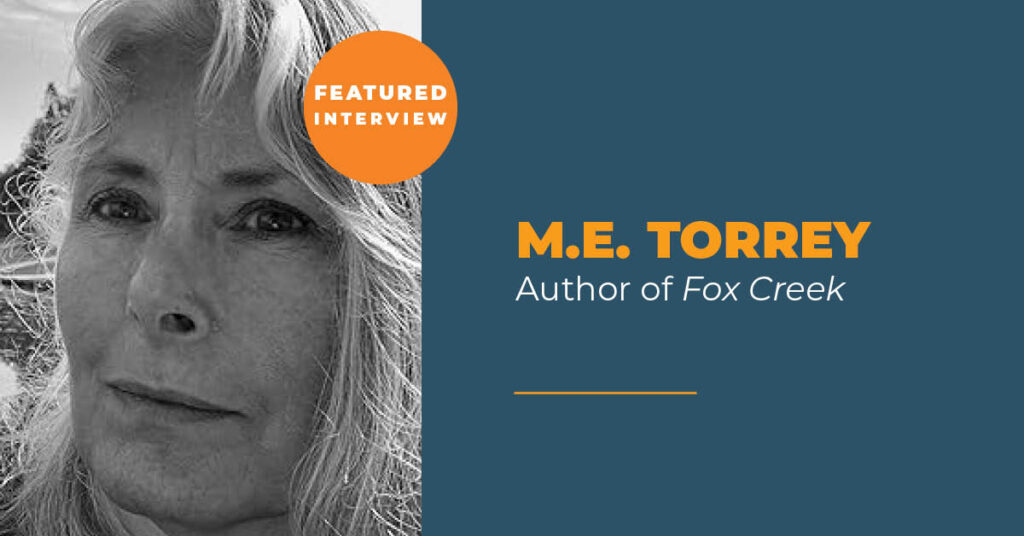
Author of Fox Creek
By Sarah Kloth
For readers meeting Fox Creek for the first time, how would you describe the book in your own words? What should they know going in?
MET: Fox Creek is one of those immersive novels where you feel like you’re actually there—living and breathing the everyday. You’ll feel the rhythm, the pulse of plantation life in 1843 Louisiana. Wisps of cotton floating through the humid air. The whack of the machete as it cuts down the sugarcane. The smell of Cook’s fresh pralines. And the pain of a mixed-race slave girl who realizes that a vast chasm separates her from her white playmates.
Don’t enter Fox Creek thinking it’s one of those quick, summer reads. Instead, enter it with the understanding that you will come to know these characters as if they were your own family, your own blood. Sometimes you’ll cheer them on; sometimes you will be horrified. And through it all, one thing is certain: these characters will live on long after you close the book.
You’ve shared that Fox Creek actually began as a young-adult ghost story set in New Orleans yet turned into something completely different along the way. What happened?
MET: I had an opportunity to visit Louisiana for the first time back in the mid-90s. As a writer of middle-grade and young adult novels, I decided to write a ghost story based in New Orleans. How cool would that be!? To prepare, I researched the city and its myriad of spooky folklore. However, once I was there, no spooky plot or creepy vibes came to me.
Instead, I felt drawn to the subject of slavery, as if I were being pulled in that direction. I rented a car and headed north to “Plantation Alley.” What happened there changed the trajectory of my writing and, looking back all these years later, even the trajectory of my life.
As a Northern girl, I was (naïvely) expecting a balanced telling of plantation life. But in tour after tour, the docents spoke only about the white family and their (wondrous) lives in the “big house.” Not once were slaves mentioned. I remember thinking to myself, “But what about all the slaves who made that wondrous life possible? What about them?” After each tour, I wandered behind the big house to see the slave cabins, if there were any still standing. Invariably, the cabins were small one- or two-room, wood-slat hovels where entire families were born, lived, and died. Seeing this, and after hearing nothing but the glorification of the plantation past, I returned home on fire. I decided to write a novel which spoke, not only to the white experience, but to the black experience. Of particular interest to me was where those narratives intersect. After much research, I wrote my debut novel for adults titled, Fox Creek.
The novel opens with Monette—a six-year-old Creole girl, the cherished daughter of a French sugar planter—who is sold into slavery on the day her father’s debts come due. What drew you to her, and why did you choose her as your way into this story?
MET: To write about the intersection of both the black and white narratives, I decided to have a character who is both white and black. As the beloved daughter of a white man, little Monette is initially raised in extravagance and wealth, believing herself as belonging to those in power—those who are white. But when she is sold, she is suddenly and mercilessly plunged into the world of slavery. Of course, she doesn’t understand what has happened to her. As the novel progresses, Monette must straddle that line between white and black, being part of both, yet belonging to neither. It is through her struggles that we experience that painful intersection, that collision, of realities.
Some of the most moving scenes early in the book are between Monette and Cyrus, the two children thrown together in the back of a slaver’s wagon. The bond they form runs through the whole novel. How did you find it?
MET: Fox Creek is the first book in a trilogy. The trilogy starts in 1843 and ends shortly after the Civil War in 1867. I wanted a love story to be the connective tissue that binds the entire trilogy together, a love story between two slaves: Monette and Cyrus. I wanted their bond to begin when they are very young, a bond forged in the fires of a mutual tragedy—their separation from their families and all that is familiar. Because they are the only children in a large slave camp in the frigid winter of the Louisiana swamps, they form an immediate bond, clinging together throughout their ordeal.
One scene that really stays with readers is at the New Orleans auction, when eight-year-old Breck Jensey buys ten-year-old Cyrus on the block. It’s a small act of recognition between two boys, but it happens inside a transaction. What were you hoping readers would feel in that moment?
MET: By the time they arrive on the auction block, Cyrus and little Monette have forged a bond of love. Their bond is threatened once they are put up for sale; it might be the last time they see each other. While Monette is numb with terror, Cyrus is determined that they stay together. Monette is first on the auction block and is purchased by the Jensey family as a playmate for their daughter, Kate. Once it’s Cyrus’ turn on the block, he recognizes Breck Jensey as a boy he saw earlier on the streets of New Orleans. In that encounter, Cyrus and Breck had a moment of connection, a fragile bond. Now realizing that Breck belongs to the family who purchased Monette, Cyrus sees his chance and prompts Breck to purchase him, which Breck does. (Breck’s father, William, allows this as he’s trying to teach Breck about plantation management, which includes how to choose which slaves to purchase—what to look for, what to avoid, etc.)
The auction scene is the culmination of the first part in Fox Creek. Up until then, readers will wonder if Monette and Cyrus will get to stay together. After all, they are powerless. Pawns in a system that does not care what they want. Prior to the auction, we’ve come to know both Kate and Breck, the two children of the Jensey family. Once Monette is purchased for Kate, I would hope that the reader will be gnawing their fingernails in the hopes that Cyrus will also be purchased by the Jenseys. (Of course, you know it’s going to happen, but when it does, there’s still a HUGE relief! Whew!)
The Jensey family—William, Sarah, and their children Kate and Breck—aren’t simple villains. They’re devout, well-mannered, and by their own lights, kind. Was it difficult to write characters whose decency lives so close to such cruelty?
MET: For me, it wasn’t difficult so much as necessary. I’ve always struggled with villains who are villain-ish through and through (unless we’re talking the James Bond bad guys or the super-villains in the Marvel Universe!). As a writer of history representing people from the past, I think it’s vital to understand the nuances of what it means to be human. Humans are complex; few people are all bad. To me, it was more realistic for the slaveholding family to be “normal” even as they live within the plantation system and all it entails, including cruelty. How they explain away the cognitive dissonance within their own lives and society is very telling. For me, it is ultimately more chilling when a normal, even likeable person, mainstreams such cruelty. This type of character reveals far more about the human condition than does a villain who is easy to hate.
You spent three years on research before you even started writing—including a week at LSU’s archives in Baton Rouge, and reading hundreds of memoirs, letters, and slave narratives written by people who actually lived through that time. What did you learn in those years that surprised you most?
MET: When I began reading the memoirs, diaries, and journals of plantation owners and mistresses, I think I was expecting not to like them as much as I did. What I learned was that people are the same everywhere, including the owners of slaves. Some were benign, some were psychopaths, while most were just ordinary people getting on with their lives the best they knew how, while living in a society that condoned and normalized slavery.
But it wasn’t until I read a plantation diary called, “Plantation Life in the Florida Parishes in Louisiana, 1836-1846: As reflected in the diary of Bennet H. Barrow,” that this understanding hit me between the eyes. In his diary, Barrow would jot notes about each day: the weather, a party the night before, which fields need hoeing, how many bales of cotton had been pressed, or even loving thoughts of his wife, etc. Everyday life, some of it sweet. But every now and then, punctuating the pages like bolts of lightning, were statements like, “Whiped [sic] all my ploughers – for shallow ploughing,” and “More hands attempting to sherk [sic] for two weeks past than I ever knew, Gave a number of them a good floging [sic],” and “Dogs soon tore him naked, took him home before the other Negroes at dark and make [sic] the dogs give him another overhauling.”
What I realized was this: even ordinary, “kind” people could become numb to the cruelty around them, especially when such behavior has been present in their lives from the time they were born, is condoned by society, and emulated by their neighbors. What I also realized was, put in a similar environment, most of us would have thought such behavior both normal and necessary. There are few of us who, when everyone else is swimming downstream, try to swim upstream. You will be outcast. This “go with the flow” behavior was also supported by federal law: slaves were legally considered only 3/5ths of a human being. It was accepted knowledge throughout the United States that they were less than.
One other thing I learned from my research: Owning slaves was considered the pinnacle of Southern manhood. At the height of the slave market in the South, a male slave in the prime of his life sold for about $1,000. This is the equivalent to $44,000 USD today. Many white men worked and worked until they could (finally!) purchase their first slave. Owning a slave afforded some respect. Now imagine owning ten slaves. Or one hundred! It was no mistake that those in power in the South were all slaveholding white men. That’s where the wealth was, and, like today, they would do anything to protect their wealth—even send their sons to war.
Most stories about the antebellum South are set in New Orleans or along the Mississippi’s grand plantations. You set Fox Creek in West Feliciana parish, a less-told corner of Louisiana. Why there?
MET: Actually, Fox Creek begins at one of the grand plantations along the Mississippi, where little Monette was born. However, we soon move to West Feliciana parish which, together with East Feliciana parish, was known as “English Louisiana.”
While the French settled along the shores of the Mississippi in the late 1600s, the English really didn’t come along en masse until the Revolutionary War. Loyal to the English king, these wealthy colonists fled inland from the eastern seaboard. Some of them settled in East and West Feliciana, a place of streams, rolling hills, fertile soil, woods, and plentiful wildlife. There, they extracted wealth from the land, building plantation homes that emulated their homes in the east.
“Plantation Alley” is located in West Feliciana. One plantation, Nottoway, boasts 53,000 square feet and is the second largest plantation home in the South. Another, Oak Alley, was Louis’ home in “Interview with a Vampire.” Bennet Barrow, the writer of the diary, was master at Highland Plantation, located in West Feliciana. As he provided such an insightful glimpse into the mind of a slaveholder, this really decided it for me.
Fox Creek is your first novel for adult readers after writing twelve books for children. What did writing for young readers teach you that you used here, and what did you have to leave behind?
MET: In writing novels for middle-graders and young adults, I learned the basics of good fiction: characterization, plot, story arc, pacing, setting, imagery, point-of-view, voice, and so on. Without knowing these fundamentals of fiction-writing, I would have floated aimlessly hither and yon like a buoy without a tether.
To answer the second part of this question, I will have to say that I didn’t leave anything behind. In fact, I find writing for an adult audience to be freeing. Often people think writing for children is easier, when, in fact, I find it harder. Why? 1 – You are limited in thematic material. You can’t get too gory. Too sexy. Too graphic. Too esoteric. 2 – The protagonist must solve the problem themselves. You can’t have adults rushing in to save the day. Well, that’s hard plot-wise because that’s what usually happens in real life: we call the police; we call the fire department; we call our parents. Nope! Your thirteen-year-old protagonist has to escape his kidnappers on his own, or only with the help of other kids, and you can’t make it feel contrived. 3 – You have to keep a lid on your language. No f-bombs for twelve-year-olds. No florid language that puts them to sleep. 4 – Speaking of sleep, you have to grab a young reader from the beginning and never let them go. Your 15-year-old reader? They can watch TV, chat with friends, stream anything, play video games. Why should they sit down and read your four-page exposition on how the land was settled? So, there has to be tension, lots of tension. Keep them hanging. Questions need to be posited but not answered right away. (Will he escape? Will Celia understand the secret message? When will the truth be revealed?)
I could list more, but you get the idea. . . .
Fox Creek is the first book in a trilogy, and the ending leaves readers with a powerful, unresolved image. Without giving too much away, what can readers look forward to in Books Two and Three? And when they close this first volume, what do you most hope they carry with them?
MET: I’ll answer the second part of your question first. Certainly, I hope my readers will have learned something about the antebellum South—as an immersive experience rather than a recitation of facts. I hope that they will feel that they’ve been there, touching the soil and breathing the air. I also hope my readers get a sense of the vast injustice that was perpetrated against a race of people, and even how some of those injustices perpetuate today. But most of all, when readers turn the last page of book one, I would hope that they carry the characters with them in their heart, pondering about them in the days that follow, and imagining how their stories might continue.
In book two, we see Monette and Cyrus’ love story continue. We see what has happened with the Jensey family and with Fox Creek Plantation itself. A few new and vital characters are introduced. Book two ends on the eve of the Civil War.
In book three, we continue the story of the Jenseys and their slaves throughout the Civil War and beyond. While the men go off to war, war eventually finds those left behind. It becomes a story of survival, of justice, and of love.
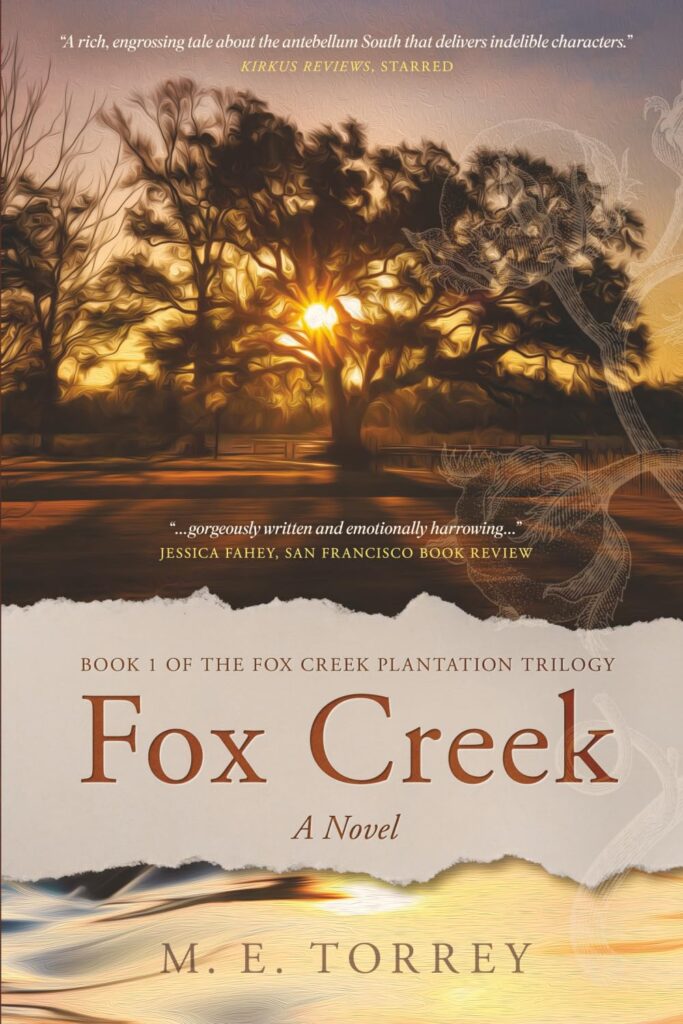
Fox Creek
By M.E. Torrey
The year is 1843 when six-year-old Monette, the pampered and beloved daughter of a French Creole sugar planter, is taken to New Orleans and sold into slavery. Sold along with her is Cyrus, a boy big for his age, torn from his mother without a chance to say goodbye.
Together they go to Fox Creek Plantation in “English” Louisiana, home to the Jensey family. While Cyrus is sent to the fields, Monette becomes the childhood playmate of Kate, the planter’s daughter, and catches the eye of Breck, the planter’s son. It’s easier and safer for Monette to pretend life is normal. That she belongs. To forget her past, even to forget Cyrus, whom she’d loved. But as the years pass, it becomes clear that children of color do not belong in the world of the white elite—at least, not as equals. The brutality and powerlessness of slavery begin to take their toll upon Monette.
Who is she now? Who will protect her? And who is that big boy from the fields who keeps pestering her?

Continue Reading…
Article originally Published in the Summer 2026 Issue.