
Author of Poor Damned Souls
By Anthony Carinhas
Never a dull moment these days so why not goad it on with a conversation with Charlene Elsby. A fearless author who’s changing the landscape in independent publishing. With a signature style, her work is like stepping into a portal where human-thought flourishes without constraint. What’s even more impressive is that Charlene broke free from the rigor of academia to become an artist. And boy do we welcome that!
Your work reminds me of a film called Irreversible by Gaspar Noe. Have you seen it and what are your thoughts on this landmark film?
CE: Yes, incredible film. I saw it ages ago. The last time I thought of it, my friend was trying to pick a movie for a first date, and I suggested they watch Irreversible.
You’ve done quite a bit of research in Phenomenology. What kind of experiences early in life drove you to get a Ph.D. in that discipline of philosophy?
CE: I have always had the drive to know everything, to figure everything out. I can’t handle uncertainty, and I don’t want to. Phenomenology is the method of examining our experience with the aim of any given phenomenon to its essence. That kind of analysis appeals to me as a way of stripping away all the noise of human existence so we can focus on what matters. I chose to focus on phenomenology, because of all the philosophical methods, this one leads to correct insights, and the questions that they tend to focus on are the ones that interest me. Art, consciousness, the divine, patterns in the world and how we experience it. Phenomenology requires a heightened capacity for honest self-reflection, which is a quality I aim to embody, and which I admire in others. Now when I’m writing, I engage in a similar method of systematic self-awareness, to expose the raw truths undergirding our experience. I want to reach that moment of insight that phenomenologists refer to as eidetic intuition – when you analyze something so hard that its essence appears to you, clearly and fully. Once one person does that and speaks about it, other people can find the same truth more easily, and the scope of the body of knowledge available to human consciousness grows.
Did you ever get a copy of Pearl Death as a deck of cards because only a whopping 160 copies are in existence? Who knows—maybe Yeager slipped you a copy from a secret stash or something.
CE: I have a copy of Pearl Death. I cannot reveal where it came from. 😉
Tell us about life in Ottawa, Canada.
CE: Ottawa is, on its surface, a very bureaucratic city. You can tell by the orderly way things are arranged. We have a reputation for tending away from extremes. Because it’s the capital, we have to keep up appearances. It’s taken a while to find the right people to be weird with, but they’re here. My life at the moment is pretty standard fare. I work, I pet my cats, I commandeer little bits of the lawn to increase the capacity of my vegetable garden. So far the landlord and other tenants have been understanding. Sometimes I look at my phone and see that someone has said something nice about me on Instagram, then I go back to doing the dishes.
What affects your creativity more — hot summer nights or cold winter nights?
CE: Interesting question. I have noticed I tend to be more productive on cold winter nights, perhaps because it gets darker earlier. Whereas hot summer nights provide the opportunity to live life in a way that feeds inspiration. I think when the cold and the dark sets in, I tend to ruminate more, and that is only expelled in the writing.
What’s your favorite horror short story?
CE: I thought about this question way too long. When I read something, it leaves my brain immediately. But one that will never leave me is “Gigi’s Hands” by David Simmons. He performed it at VoidCon 3, and BR Yeager recorded it and put it up on Youtube. The absurdity coupled with sentimentality reflects our mode of being in the joke that is the world, and the way Simmons puts that into text makes me believe that there’s a way to exist with charm and grace despite the horrors.
When people vibe with deranged transgressive fiction rather than see it as grotesque. What does that say about the zeitgeist?
CE: I think we’re all getting weirder. I don’t know if it’s collective trauma from living in the contemporary world or collective psychosis due to COVID or whether this is just how things are now, because we’re following some divinely ordained path that leads humanity to confront its individual and collective demise, but I’m here for it.
Your newest book Poor Damned Souls unmasks how unrealistic expectation, paranoia, and ergonomic overload can thrust any rational person into a cataclysmic fallout. What steered you to write this story with a noticeably edgier vibe than previous work?
CE: Is it noticeably edgier? Probably compared to The Organization, but I’d put it on the same edge level as Musos or The Devil Thinks I’m Pretty or Violent Faculties. I don’t consider edge when I’m writing; it’s just the nature of the demon that needs to get out. Poor Damned Souls is what happens when someone with that set of proclivities has a particular set of
formative experiences that, when subjected to constant demoralizing stressors, tip the balance of an individual into the realm of evil. I use “demoralizing” on purpose here, which we tend to think of as a lack of motivation, when the word actually connotes the degradation of morality – persistent, unmitigated damage makes us worse people. I was grappling with that feeling we get when we realize we can’t control the world, the past, or even know our loved ones.
As the narrator in Musos rattles between psychosis and consciousness, it seems like he suffers from delusions of grandeur. The diary format works really well since it lets us see how constructs distort his reality—things like socially prescribed perfectionism, mental illness, inferiority complex and mimetic desire. It also can’t be denied that there are people like this wandering in society where you least expect. So with all the crossover between Laura, Void Man, and Ditch Man Dandy—how challenging was it to keep the narrative from getting too avant-garde and unconvincing?
CE: I can’t say I was too worried about that. I have found that the reader is capable of providing all sorts of context and frameworks that make what they are reading make sense. Musos was actually my first novel, written years ago, and then I revived it, rewrote and added sections. I remember a publisher I had submitted it to while I was an undergraduate returned it with the comment “unreadable.” Perhaps people have gotten better at reading.
Will Musos ever be available for purchase again?
CE: I think not. The void man is dead.
Psychros is a humorous portrayal of neuroticism on full display—a bleak character study on someone having to deal with unresolved issues overnight. It’s noteworthy to mention how fascinating it was to follow the trajectory of deluge the female protagonist personifies after her boyfriend’s death because it allows us to see how gender, norms, life, death and the status quo impact her thinking. Since grief isn’t a mental illness—why is rage overlooked as a tool to process trauma?
CE: I think because we’re scared of it, and rightly so. The acts that a person can perform when even a justified rage is allowed to surface are abominable. It’s a way of externalizing all the shame and helplessness a traumatized person feels.
Like a cornered animal, we go on the attack. One inference from this is how now, more than ever I think, we sympathize with the villains, because they are just people who have been hurt. But another inference is that we need to protect ourselves from those who have suffered. Which doesn’t appeal to our intuitive sense of moral obligation for victims, but becomes necessary as a practical way of protecting ourselves from other people’s pain, which could easily turn against us.
Violent Faculties follows a ravenous professor that takes human experimentation to a whole new level after mid-level administrators close the philosophy department (this is later clarified in the novel’s appendix.) Very original to turn this bloodbath into a thesis-like document as victims are pulled into a makeshift torture chamber inside her house. By this point in the story it’s clear that all the coercion ends up becoming the same soulless attack the university used to close the philosophy department. Is this story just a caricature to peoples’ cynical view on higher education’s transgression that values profit over knowledge?
CE: We are right to be cynical about higher education’s valuation of profit over knowledge. Too many businessmen who conceive of the university as a business and its students as clients have degraded education and its purpose, which ideally would contribute to our human capacity to live a fulfilling and happy life. By nature, we desire to know, and the pursuit of science and philosophy is undertaken for its own sake. To pretend that profit is
the goal subverts that purpose, and prevents the academy from contributing to humanity’s happiness. Instead we have businesses that sell degrees they claim will one day be profitable–the goal being to raise the income of the client. But they’re just shifting the responsibility to individuals for the cost of training their ideal employees. Now institutions seek advice from local business councils about what they believe their future employees should know and shape the degree offerings accordingly. The goal is to produce workers, not humans, and the shift in how education is delivered and what it delivers is palpable, and it’s slimy. Ultimately it produces an environment where fundamental truths about the universe are skipped over, because they’re not profitable. But they are valuable, and people live worse lives never having access to that form of knowledge. I made this argument for several years before writing Violent Faculties.
The Organization is Here to Support You is an amusing look into the degrading world of modern life. It’s a callous look into a bureaucratic business that cultivates conformity, ambivalence, mediocrity, anxiety and misogyny where Clarissa Knowles works and lives. Even though she’s moderately content with the controlled communication between everyone in the company—freedom seems to invoke oppression around the office. But the real horror ends up being the moment when the reader realizes that their everyday life is mirroring all the demonstrate how salacious and brusque short fiction can be—hence the title of the book?
CE: Writing The Organization was really fun. I had just read The Village of Stephanchikovo by Dostoevsky, and I decided that I, too, could write a comedy of misunderstandings. I had just left academia and begun work in a more corporate environment, and I figured I’d better write down all the horrors before I changed to the point where it started to seem normal. I had gone from teaching Sartre, and lecturing about how we alienate ourselves from ourselves in order to adopt a role that is foisted upon us by capitalists to actually taking on one of those roles. And I know that over time, we conform to the role we’re in – we start to care about the things we’re doing, just because we’re doing them, and even feel ways about it. So keeping track of the absurdity became a very important cope that gave me a lot of joy, and now serves as a constant reminder that we need to keep in touch with our core selves and have things to value that aren’t work. It’s been great for work-life balance, which didn’t exist in academia.
Bedlam is a collection of fourteen stories soaked in copious realism. I’d say it’s a solid introduction to your material if no one’s read your stuff before. Notable stories are the mice that multiply in the aquarium called “So Many of Them,” and “Dieu Seul: The Death Sentence,” which is about hopeless emptiness. There’s a lot to devour in this assortment of stories which prove why you’re one of the most ominous authors in indie lit today. When you put this anthology together, were these stories too short at being a novel or did you want to demonstrate how salacious and brusque short fiction can be—hence the title of the book?
CE: The stories in Bedlam were all meant to be short stories. Some stories are meant to be short, and others long. They were written as long as they needed to be. When Apocalypse Party opened for pitches, I thought of collecting them into a book. I sent them a selection of stories and they were interested, so I sent them the balance of what I had written over the past few years. They selected which ones were the best and that would make the most cohesive book, and that became Bedlam. I didn’t have a title at the time. That came later, and when it did, I was thinking of the asylum. People have pointed out to me how “bed” + “lam” might be a clever combination that reflects how the stories focus on sexual experiences and the drive to escape, and I like that interpretation as well.
A neu era of technological overreach has warped peoples’ realities for better or worse these last five years. Its transfiguration is felt everywhere. What future do you see for humanity by the year 2076?
CE: Oh wow, this is heavy. The future is something I tend to avoid, just because of its uncertainty. I’m a strong believer in that nothing is determined and free will most certainly exists. At the same time, it feels like certain events are fated, and no matter what we do, those events will come to pass. I’m looking at AI and how it’s trained on human consciousness, and it looks like a regression. The magic of humanity is our capacity to reject all that’s come before and declare something new, which is something the machines can’t do. I’m waiting for consciousness to emerge from the machine, and I hope it comes in a form that doesn’t ensure our destruction.
Any authors you want to shout-out right now and why?
CE: You have a lot of them in your intro. Ira Rat is a gem and seems better known for Filthy Loot than his own writing, but we also need to recognize him for his affecting, castigating prose, taking humanity to task for its faults as it reveals the depth of our wounds at its hand. OF Cieri writes like she’s taken possession of the human experience, and I just hope there’s some left for the rest of us. Shane Jesse Christmass is in a class of his own, but I will join that class later this year when our collaborative book is released. BR Yeager’s next book is brilliant, as we have come to expect from the master. I’m going to add Michael Tichy, whose facility in expressing the undulations of the mind can make you feel like you didn’t notice the thousand punches as they were happening, even as they have assured your demise. Also Evan Dean Shelton, as I wait for him to write the novel that will end it all. Elle Nash is someone I cherish, for her extreme talent, empathy, and force of intellect.
Did you read Molly by Blake Butler?
CE: Yes, and I talked about it with my therapist. Blake Butler is one of our greatest living writers and a wonderful person.
When do you think someone will write a horror book on looksmaxxing?
CE: Now. I’m at the cafe answering these questions and looking at Shelley Lavigne, and they’re doing it now.
We lost a timeless treasure last year—David Lynch. Like others, did his art influence you?
CE: Absolutely. I remember watching Blue Velvet as a teen. I was team Isabella Rosselini, and I hoped she and Kyle McLachlan would end up together. In retrospect, that was probably fucked up of me. When Lynch died, I was invited to write something for a lit mag about his influence, and the piece ended up being rejected. I might have gotten too weird.
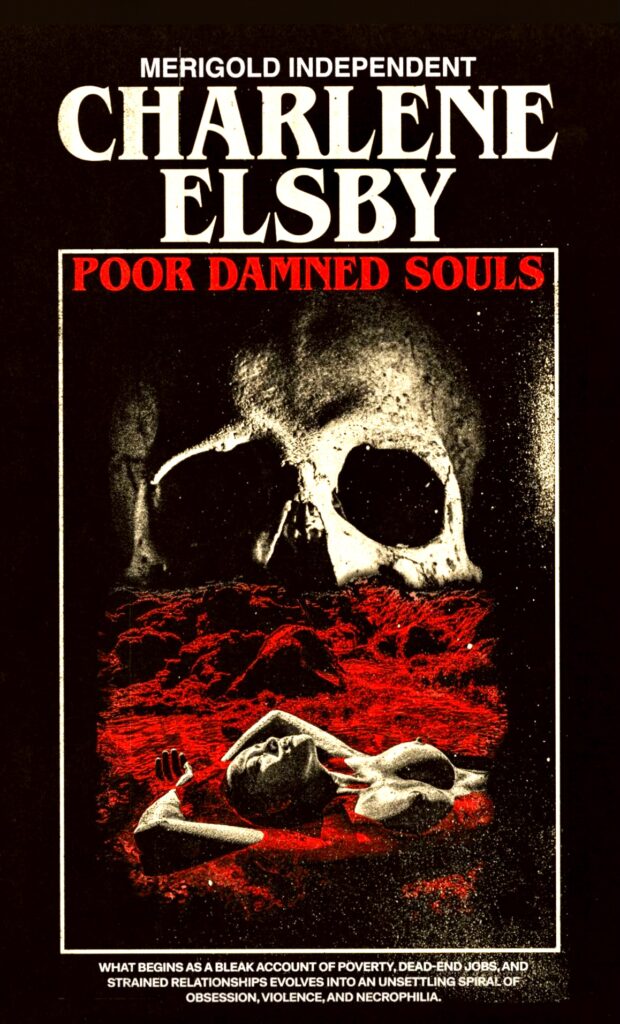
Poor Damned Souls
By Charlene Elsby
Love, suspicion, necrosis…
The ticking of The Money Store’s 15-minute safe, the hum of fluorescents over gray carpet, the afterimage of a browser window, the weight of someone else’s breath in your throat. What is a betrayal and how far can it go? Does it count if you cheat with a dead girl?
Poor Damned Souls is a drowning that never ends, a bleak and violent look into the psychological spiral of a woman convinced her partner is cheating when he’s actually killing, and her subsequent deep dive into murder and the circumstances that lead there.

Continue Reading…
Article originally Published in the Summer 2026 Issue.