
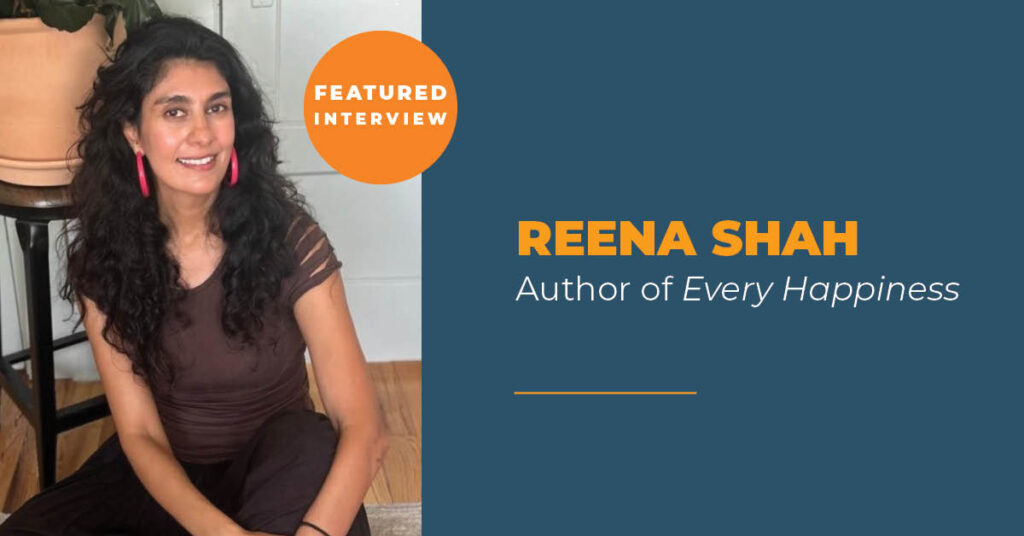
Author of Every Happiness
By Sarah Kloth
Every Happiness spans decades and continents, beginning in 1960s Mumbai and moving into suburban Connecticut. What first drew you to telling this story across such a wide emotional and geographic arc?
RS: I began writing this novel before I knew I was writing a novel. Every Happiness started as a short story that focused on the relationship of a woman and her son. The son is born with cosmetic facial differences and is also an ill-tempered and brooding child who refuses to play into the tropes of Asian American exceptionalism. In the story, he and his mother, Ruchi, are at this party where his mother is consumed with envy for the more successful South Asian families with high-achieving kids. At that point, Deepa, the host of the party, was more of a foil for Ruchi than a fully drawn character. But something about that didn’t feel right. I kept trying to push a narrative on Deepa, this difficult friend, and this narrative kept failing. For years. And then I went to a residency and the instructor there said, “You’re trying to make Deepa a villain, and that’s false. She’s not a villain here.” I hated this advice for a long time. And then I realized this man was right. That’s when the story began to become more than a story. I began writing other stories about these characters, which became a linked collection that became a novel in stories, and then a novel. I’m not exactly sure what the lines are between these three designations, but I do think that by not setting out to write a novel, I could move around in time and space with more freedom. I didn’t feel bound by linearity and my false notions of what a novel was supposed to do. I was writing the scenes I saw in my mind and following the characters’ lead.
Deepa and Ruchi’s relationship begins in childhood and evolves through intimacy, rivalry, and what has been described as “suppressed desire.” How did you think about sustaining that emotional tension across their entire lives?
RS: I didn’t know what would happen until it happened on the page. That sounds a bit woowoo, I know. But in early drafts, I wasn’t making decisions as much as I was considering Ruchi and Deepa’s choices. Scene by scene, the characters revealed themselves to me and it wasn’t until I was a couple drafts into the book that I realized what was happening to Deepa and Ruchi, how much their friendship was an obsession and a lifeline and full of unrealized desires. While I didn’t set out to do this, Ruchi and Deepa are modeled after women I’d grown up around who struggled with remaking themselves as immigrants, as wives, as daughters, as mothers. At times, I felt suffocated under the weight of their expectations as a child, but as I’ve gotten older, I’ve realized how much they sacrificed of themselves to be a “good Indian woman” or a “good mother” or a “good immigrant”.
And yet, I think the desire and longing between Ruchi and Deepa keep them alive. Without it, what would life be for them? In another life, these women might have lived openly as queer women. They might have gotten together and broken up and remained friends. They might have never spoken to the other again. But they would’ve had some fulfillment. Some resolution. The push and pull between Ruchi and Deepa, who they are and who they wish they could be, forms the emotional backbone of the story.
Why was it important for you to explore longing and connection through a lifelong friendship rather than a traditional romance narrative?
RS: I think friendship is a powerful relationship, though the sound of the word, with the short /i/ and the voiceless, fricative /f/ make friendship sound flimsier than it is. It’s a relationship of choice that often doesn’t involve the usual, normative obligations of blood family and romantic partnership. Ruchi and Deepa are girls in the 1960s in Mumbai who don’t have many choices available to them. They can’t choose where they go to school, how they live, and whether to marry. But they choose each other, and that becomes very powerful for them, a touchstone through the course of their lives.
I think friendship can be just as powerful as any romance, and I also think that friendship and romance aren’t entirely mutually exclusive. I think you can be a little in love with a friend just as you can consider a romantic partner a friend first. Are Ruchi and Deepa a little in love with each other? A lot? I think so. But I also think they’ve been taught to fear their desires and their choices and to distrust their bodies’ impulses.
How does the cultural shift from post-colonial India to suburban America reshape the ways these women understand identity, femininity, and obligation?
RS: As girls, Ruchi conjures up lots of fantasies about what their futures might look like, and she tries to get Deepa to buy into these dreams. For Deepa, her fantasy is about being made new in the United States. To move so far away in their early 20s is terrifying to both, but Deepa in particular hides her fears behind utopian images of what America will be like, how much freer they will be there. They are born in 1950, 3 years after the subcontinent’s independence from Great Britain, a time of great upheaval and pressure to be a good, Indian girl. Immigrating to the United States seems to offer an opportunity to “make it”, to prove that they can be more than what’s expected of them. But the reality doesn’t match the fantasy. The reality is much harsher, much lonelier, much more disorienting than any of the characters can prepare for. Ruchi and Deepa are made new in that they must navigate womanhood, femininity, and their duties in a completely different environment with no guides.
In what ways do Deepa and Ruchi carry their cultural upbringing with them into their adult lives in the United States, and where do you see those inherited expectations beginning to fracture?
RS: I’m not sure what life would’ve been like for Ruchi and Deepa had they never immigrated, and I think it’s a question that haunts them, too, and a question that was present in my own upbringing. It was like a parallel, ghost life was happening in the homeland that could only be imagined. While both Ruchi and Deepa try to look forward only, the past, and especially their shared past, keeps infiltrating their lives. In different ways, they’ve been taught to see marriage as an antidote to loneliness and for Deepa in particular, she’s hoping that following the rules—marriage, having a kid, acquiring material wealth—will cure her of desires that she’s ashamed of. Heterosexual life is the only acceptable model that’s presented to her. Even though her own mother is separated from her father and essentially raising her daughter on her own in 1960s Mumbai, which makes her an outlier at the time, Deepa is still expected to be a “normal” woman.
I think Ruchi triggers the fracture. I think of her as deceptively quiet. She seems like the meeker, more submissive girl and then woman of the pair, but it’s Ruchi who makes the boldest, and most honest, choices. She insists on maintaining a relationship with Deepa, and while some might say this is an unhealthy obsession, I think Ruchi also pushes against repression and expectations in ways that charismatic, seemingly outspoken Deepa is too afraid to. I’m interested in characters like Ruchi and Deepa whose exterior contradicts a more complicated interior.
The immigrant experience in the novel feels deeply layered, especially as the women navigate assimilation, marriage, and motherhood. What were you most interested in exploring about cultural adaptation versus cultural loss?
RS: I think it’s a precarious dance between trying to belong in one’s new, adopted home, and giving up parts of yourself to belong, especially when the new place doesn’t accept you as you are, or thinks you’re weird or thinks your food smells or that your names are unpronounceable or that your clothes are costumes. I think Ruchi, Deepa, their children, and their husbands experience these cultural rejections individually and it adds to their shame. As I was writing, I became interested in showing how potent a feeling shame is, and how harmful when left unresolved, when internalized. I also noticed that people find ways to protect themselves from it and survive. Cultural centers are part of this. I’m fascinated by ones that pop up in places outside of metropolitan areas, like the one Deepa establishes in a strip mall in suburban Connecticut. I think these places are dreamt up as a form of self-care to protect against erasure and assimilation. Of course, Deepa’s cultural center becomes something very different from what she sets out to create as politics in India seep into the burgeoning community in Connecticut. But it’s still an effort to create a place that feels like home.
Both women become mothers in very different ways, with contrasting emotional approaches. How did you think about motherhood as a reflection of both culture and personal history?
RS: I’m glad you see that both culture and personal history play a role in how Ruchi and Deepa approach motherhood. Both women are haunted by their own mothers as they raise their children, even though by and large those mothers have been left behind. But their upbringings leek into how they parent. Deepa is emotionally distant from her daughter and Ruchi is overly vigilant of her son and yet both women parent from a fierce desire to protect their children from psychic and physical harm. I began writing this book after I became a mother, and I think that experience has made me interested in the precariousness of motherhood. What is the line between protection and control? How much vigilance is too much? How do you reconcile your own vulnerabilities with your child’s needs?
I think these women also worry about their children becoming cultural foreigners to them. Ruchi whispers Gujarati words to Moksh when he’s an infant, and Deepa insists that her daughter attend prayer ceremonies that she herself hated as a child. Their sense of “Indianness” is stuck in the 1970s, the India they immigrated from. What they pass down to their children is like a cultural time capsule, and their kids have to make sense of it.
I also keep thinking about how young both Ruchi and Deepa are when they become mothers. They’re only in their early 20s. I was in my mid-30s when I had my first child, with a whole community around me for support, and I still felt unprepared. For Ruchi and Deepa, I imagine that feeling is amplified by 100.
The novel also engages with class disparity as the women’s lives diverge in America. How did that shift affect the balance of power within their friendship?
RS: That’s a great question. I think perceived class disparity plays a role in Ruchi and Deepa’s friendship right from the start of their relationship. Deepa gives the appearance that her family has more money than Ruchi’s, when her family’s wealth has crumbled. It’s why both girls attend the same low fee Catholic school. While it’s a reach for Ruchi’s family to send her there, it’s a demotion for Deepa’s family, and this subtle difference is one that Deepa plays to her advantage. Money is as much a part of their origin story as attraction.
When they move to the United States, this disparity grows. Often immigration is tied to the idea of “wanting a better life”. A “better life” involves money and the chance to chase it, grow wealth, and live comfortably. And based on these metrics, Deepa finds this better life in the United States, while Ruchi struggles. Deepa’s husband, a doctor, finds more financial success than Ruchi’s husband. She has status and power and helps Ruchi pay for groceries and find a job. But I think status and power are also a trap for Deepa. The “better life” is an illusion. She thinks money can cleanse her desires, make her an acceptable woman. She also feels the pressure to keep up with the Jones. “What will people think” becomes a constant concern for Deepa as she climbs the economic ladder. Ruchi has less to lose and maybe this is why she can take more risks in pushing the boundaries of their friendship.
One of the children in the story struggles with an eating disorder. What led you to explore this specific vulnerability within the broader context of diaspora, expectation, and control?
RS: Though I didn’t plan for it, food became important in the book. At different times it’s a marker of class differences, a love language, an obsession, and an object to control. For Moksh, Ruchi’s child who develops an eating disorder in his teens, his struggle grows out of all these things. He’s very aware of his appearance and body throughout the novel. He can’t control the structure of his face or how people view him, but he can control what he puts into his body, and this becomes a secret satisfaction for him. It’s an experience I’m familiar with in that I also developed disordered eating habits in high school. I didn’t realize it then, but I think that, like Moksh, eating became an activity I could have agency over at a time when I felt so out of place in my surroundings.
As a former Kathak dancer, how does your background in movement and performance influence how you write physicality, intimacy, and emotional expression on the page?
RS: Kathak is a North Indian classical dance form characterized by intricate footwork, hand gestures, and spins, and I’m grateful that I had a chance to studied it in depth. Movement has always been important to me in that I feel best when my body is in motion, which is perhaps antithetical to being a writer. But I find that engaging in movement helps me write and focus my mind. Kathak, like all Indian classical dance forms, is also storytelling form, though what first drew me to the form was its aesthetics. Kathak made me attuned to how bodies move in space and how movement conveys emotion. In Every Happiness, the characters pay a lot of attention to physical proximity. As uncomfortable as they are in their bodies and with their desires, they’re also hyper aware of how close they are to others and to the slightest touch. Every physical moment of closeness is charged and catalogued.
When a long-buried secret involving Deepa’s husband is revealed, the novel shifts in tone and stakes. What interested you about testing friendship against moral rupture?
RS: I think this moral rupture is connected to the characters’ desire to be good and worthy individuals. As immigrants and children of immigrants, I think all of them, in different ways, feel pressure to prove their worth in America. Often this worth is measured in financial success, chasteness, and achievement. But these standards are impossible to live up to. I was interested in seeing what would happen if a crime, in this case Sanjay’s medical fraud, was committed. Does that kind of disturbance help each character see what’s important? Or do they double down on chasing a hollow image of goodness? For both Ruchi and Deepa, their sense of right and wrong is challenged. It turns out that being good is easier in the hypothetical. It’s easy to say, I’d never steal or commit fraud when the choice isn’t right in front of us, when the choice isn’t bound together with survival or family or identity or economic precarity. In this scenario, is friendship expendable? Does it become a less essential relationship than familial relationships?
The title Every Happiness feels both expansive and slightly ironic. What does “happiness” mean to you in the context of this novel, especially in relation to sacrifice, cultural expectation, and survival?
RS: I’m glad you see the irony in the title. I think happiness in this novel is illusive and largely misunderstood. It’s wrapped up in success and appearances and repression, which are false paths. These characters equate achievement to money to happiness and love, which reflects the society they’re living in, one that conflates contentment with material wealth, status, and power. To different degrees, the characters in Every Happiness feel they must silence their desires to achieve happiness. And yet, they keep trying. They show up for each other. They try to give each other grace.
While I think “Every Happiness” is the right title, it wasn’t the first one. In early drafts, the title was “Just Here Only”, which is a common phrase in India. While asking for directions a person might say the place is “just here only” and give a set of instruction that are wildly off the mark. And yet, I find something comforting about someone trying to reassure me that that’ll get there. I think the characters in this novel are giving each other “just here only” directions to find intimacy and happiness. There’s a lot of love between them, and there’s also a lot of uncertainty and jealousy and shame that complicates their love and their paths to happiness. I won’t give away the ending, which is one of my favorite parts of the novel, but I like to think that some of them eventually find it.

Continue Reading…
Article originally Published in the Summer 2026 Issue.