
Author of Seagulls
By Sarah Kloth

Seagulls moves across cities, borders, and perspectives with an almost tidal rhythm. What first inspired the structure of the novel?
NC: I wanted first to show the main characters in the lives they’ve built after the immigration. The first three chapters follow these women after they’ve already left Ukraine or Russia – we meet them in Barcelona, New York, and Istanbul. The sense of loss surrounding events as monumental as immigration, war, or displacement can be overwhelming, so I wanted to give these women the dignity of new beginnings. In a sense, I wanted to reassure the reader – these women are okay, they make it through – before leading the reader to follow them into darker places.
After this initial flash-forward, the stories move chronologically, and we finish more or less where we started. To quote T.S.Eliot…
We shall not cease from exploration
And the end of all our exploring
Will be to arrive where we started
And know the place for the first time.
The book feels deeply concerned with displacement, movement, and survival. What drew you to writing about lives shaped by migration and instability?
NC: Seagulls began as my personal way of processing the Russian invasion of Ukraine in early 2022. I wrote a draft of what would later become one of the chapters only a few weeks into the war. As often happens, I didn’t think of it as a book when I started writing it – it was simply something I had to put down on paper, for myself, without any intention of sharing it.
Over time, writing down stories of people impacted by displacement, immigration struggles, and the intensely personal dramas of our lives – divorces, marriages, childbirth, falling in and out of love – unfolding against the backdrop of geopolitical crisis was a way for me to connect with those people, to find resonance between their stories and mine.
Place plays an enormous role in the novel—from Bridgeport to Barcelona to Batumi to Dnipro. How did geography shape the emotional landscape of the story?
NC: Every character has had to move in the course of the book, often several times, and even the places where they eventually land have a sense of impermanence, whether or not the person has imminent plans to leave. This scattered geography plays an important role in the collection. The places people move to are both highly specific and strangely interchangeable: Batumi, Istanbul, Barcelona. These are distinct cities with vibrant cultures and histories of their own, but since people arrive in these places not entirely by choice, they also become places of alienation, a temporary stop on the way somewhere else.
For Russian immigrants in particular, political constraints often narrow the possibilities to countries like Turkey or Georgia, since visa restrictions make Europe inaccessible unless they manage to secure a work visa, which is rare and difficult. At the same time, there’s a sense that these destinations could as easily be somewhere else, that tomorrow you might have to pack up and leave for another city, country, life.
The novel’s fragmented structure creates a sense of accumulating memory rather than linear narrative. How did you approach pacing and connection across so many perspectives?
NC: Frankly, I wanted to let the characters speak for themselves, and, rather than me imposing the structure top-down, to let them guide the narrative, which means that sometimes the narrative is linear, sometimes circular, sometimes more meandering – just like it is in life.
Water imagery appears constantly throughout the book—salt, tar, tides, seagulls, harbors. What symbolic role did the sea come to hold for you while writing?
NC: Since the characters are so scattered around the world, I wanted to find something in their environment that would be a kind of connecting tissue that would bring
them all together emotionally –since they couldn’t all be in the same room together. And without me really planning for it, almost all of the characters had a moment when they are looking at a body of water – the Atlantic Ocean or the Black Sea. So the sea (and, of course, the sea birds) became that connecting element between the characters.
There’s a tension throughout the novel between tenderness and danger. How did you balance intimacy with the larger political and historical forces surrounding the characters?
NC: I was particularly interested in how people experience situations that from the outside appear ‘dangerous.’ This is not to say that when you’re the one experiencing them, they are not dangerous, more that there’s a certain dissociation that comes over a person in a state of crisis. A kind of clarity – calmness even. There’s no time for worrying or doubting, only clear and decisive actions. Frequently that state is very clarifying, which is where tenderness and intimacy comes from. Knowing what’s important and what can be trimmed down.
Your prose often feels poetic and sensory-driven. How important was atmosphere in shaping the reader’s understanding of the characters’ emotional states?
NC: We catch most of the characters in a very liminal place in their lives, and I wanted the prose to reflect this. There’s a kind of groundlessness that comes after moving to an unfamiliar place – and once you’re disconnected from the environment you live in, it becomes very easy to get lost in your own head. I wanted the characters’ voices, their monologues, thoughts, and feelings, to be equally unrooted.
The book engages with contemporary migration without becoming purely political reportage. How did you navigate writing toward humanity rather than headlines?
NC: I think this, at the core, is the work of fiction. I had those big themes in mind when I started to write, of course – migration, displacement, war – but more than anything I wanted to tell the stories of people affected by those concepts that in places like New York or Los Angeles can feel very abstract.
Language itself seems unstable in the novel, with characters moving between cultures and modes of communication. How did multilingualism influence your writing process?
NC: Language is something I thought about a lot, since while most of the characters are in reality speaking Russian or Ukrainian, I’m writing their stories in English. I felt very strongly about not making the characters speak broken or accented English because that’s not how those characters would have experienced those scenes in real life. I decided that it was more important to communicate their emotional states rather than to use other languages to add ‘texture.’ Treating languages as decoration would have felt frivolous to me. When I wanted to use an expression that felt particularly true to a certain character, I included those phrases in the original Russian.
Memory functions almost like another character in the novel. How did you think about the relationship between memory, trauma, and storytelling?
NC: The collection is inspired by Anton Chekhov – the eponymous play, of course, but also the short stories – and it is his relationship to memory and time I was thinking of the most while writing. There’s a sense of nostalgia for a lost Russia that permeates Chekhov’s work and deeply moves me: nostalgia even for the Russia that still physically exists, but you can feel it already slipping away. A kind of longing that arrives before the loss itself – a sense of remembering something even while you still have it.
What do you hope readers carry with them emotionally after finishing Seagulls?
NC: Being an immigrant in America, especially outside of an immigrant community, can feel isolating. The geopolitical crises that to Americans seem very far away, feel very close to us, even if we are physically in America. Writing this book was my attempt to share that understanding with readers.
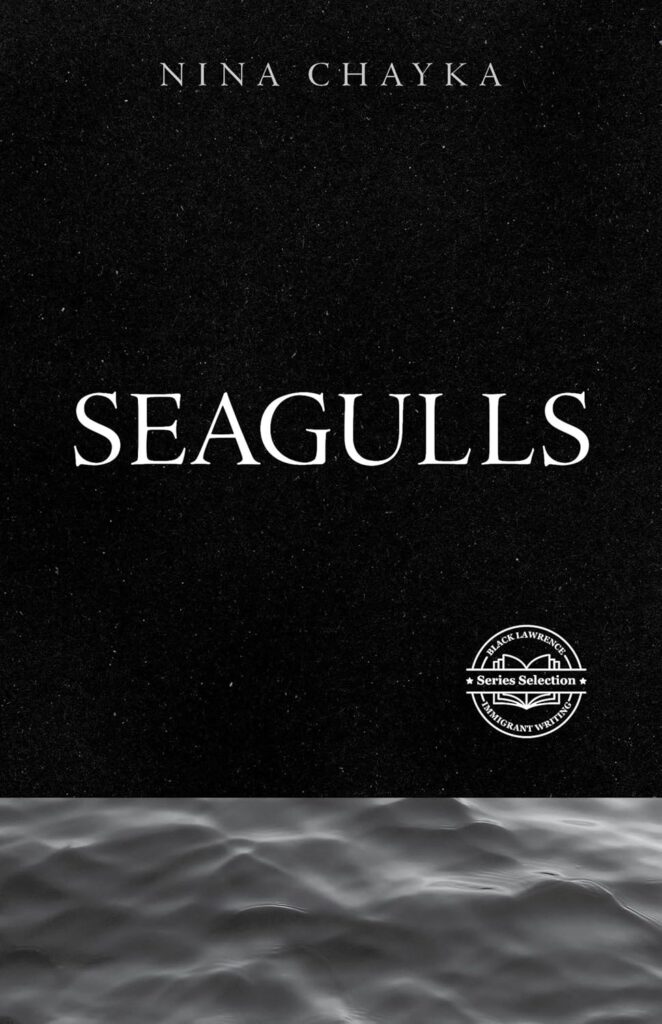
Seagulls
Nina Chayka
A teenage Olympic champion in Krakow, a stripper in New York, an American professor at Yale, a tech executive, and a doctor turned undocumented nanny—in a stunning collection of linked stories, Seagulls follows these women and men as they navigate exile, marriage, violence, and love in the aftermath of the Russian invasion of Ukraine.
Nina Chayka’s debut collection draws on stories collected by the author from Ukrainians and Russians whose lives were shattered by the war, and from the author’s own experiences as a member of a Muslim minority in Russia, her escape from harassment and threats of the Russian government, and her eventual exile in the United States.
Through these interconnected lives, Seagulls explores how individuals bound by war find the relentless, if sometimes reluctant, need to move forward.

Continue Reading…
Article originally Published in the Summer 2026 Issue.