
Author of Endless Now
By Anthony Carinhas

Was being an author always on the radar or did something happen in your life to change things?
IR: One of my earliest memories was a librarian saying, “You have the name of an author!” Before that, I didn’t realize it was a thing you could be. Later, that librarian discouraged my progress in reading by blocking me from checking out Clive Barker and William Burroughs. One hand giveth…
I’ve always been a dabbler, working in different media (music, design, art). The only constant is an emphasis on words. I’ve been focusing on writing again for the past 8 years, mostly due to reading a bad novel and going, “I can do better than this!”
So, my writing career is based on spite for the librarian and that author.
Filthy Loot is a raunchy press in Ames, IA that loves obscure horror and transgressive fiction. Since 2018 you’ve been in business. Why did you want to put skin in the game?
IR: When I started seeking publication again around 2017, I made many author friends. However, I noticed that many of the ones I liked were being overlooked, either because of their style or because their work was under the damnable 40k minimum that many other publishers adhere to.
Also, as a graphic designer, I’ve always been drawn towards covers. After looking around, I realized I could put together a better-looking book than some other small presses. Again, spite, all the way down.
Where do you see Filthy Loot in five years?
IR: All I ever want to do is put out cool things. I have no concern about whether I think something is going to sell a million copies. If I don’t like it, I pass. I want to continue that path. Every release and every year builds upon the last. I don’t feel the need to change course. In the last few years, I’ve broadened the scope by starting Talented Perverts for our literary fiction and Control for non-fiction. Mainly because 90% of what I’m reading are submissions, and I was looking for more variety.
Tell us all about Ames, IA and what’s it like living there.
IR: It’s a nice town, but it doesn’t have much to offer in terms of culture. If you were to read my stories you would think that it’s nothing but the smell of pig shit and anxiety. It is, but it’s fine. Sometimes you feel a little isolated when you’re looking at band touring schedules and seeing every one of them going the long way around us from Omaha to Minneapolis, to Chicago. But we’re only a few hours away from good venues, museums, and bookstores. It’s a nice enough place to be trapped.
And I only live 45 minutes from Francis Bacon’s painting Study After Velázquez’s Portrait of Pope Innocent X, (1953), which has to account for something?
Talented Perverts showcases paranoid and misfit fiction. A fitting label for today’s world since it seems like everyone has unintentionally become dissociative. How do you weed out material in the submission process?
IR: Originally, I was telling people I wanted work that felt like the Young British Artists movement of the 90s (Hirst, Lucas, Emin, etc.) Heady, detached, maybe a little Ballardian or in the vein of Brett Easton Ellis. I’m not sure if we ever managed to hit that target. The weeding process is the same for all of our books. I read every pitch, and if I accept the pitch, I read the entire book and it’s kind of like Potter Stewart’s definition of porn “I know it when I see it.”
I go entirely off of gut feelings, what I like, and what I can sit there and read three times to get it out there.
So, with Talented Perverts, the general litmus test is that I want something that feels arty without feeling contrived. The big inspirations for that would be Grove Press, High Risk, Semiotext(e), etc.
As for dissociation, it’s a tone that I’m looking for in the work. I think it’s the only philosophical theme worth exploring in modern life.
One of my favorite books from Filthy Loot is Shane Jesse Christmass’ Meth-DTF—a gritty story on sex, booze and drugs in Los Angeles. Go figure, right! What attracted you to this title?
IR: It feels like I’ve been reading Shane forever, though I’m sure it would have been sometime around 2019. When I did, I got this intense, overwhelming desire to work with him. So, I started emailing him, “Do you have anything I can put out? PLEASE?”
From my constant begging, I’ve now put out two of his novellas, and he’s appeared in two of our anthologies.
METH-DTF was destined to be something we put out the second I heard the name. The book’s greatness only bolstered my desire to publish it.
What’s more of a challenge—writing or editing books?
IR: Currently, the challenge is writing. I don’t have time to do it. Up until recently, I had been working on a novella that was an exploration of the Literally Me character meme, but I have the unhelpful tendency to write 10 words and delete 9.5 of them. The pieces that still worked from that are in the collection Goddamn Failure, but right now with the obligations of the press I’m officially in-between projects. However, I’m not one of those writers who feel the need to start typing without inspiration. I’m not against it. It’s just not me.
Many of your titles would look great on film. Does screenwriting, television or movie production interest you?
IR: Yes, I’ve written a few little movie guides, like a beginner’s guide to extreme horror with Jon Steffens, and I used to write screenplays. Most of the latter have mercifully died on old computers. The only script I still have floating around is the one from which the Participation Trophy was adapted. However, I’m far too busy and lack the ambition to gather even a small crew together.
Alex Osman and I talk about these things fairly frequently. So I’ll steal his philosophy that we can put anything in our books without having to deal with actually making it happen.
What material are you currently seeking for Control—your non-fiction imprint?
IR: With Control, I’m just looking for interesting takes on concepts in horror, cult, and other genres we typically cover. I’m always taking pitches. Please don’t write an entire book expecting me to love it. My ratio of submissions I receive to published books is pitiful.
Tell us about your podcast Not Worth Living.
IR: Not Worth Living is a podcast without a host… Because I kind of hate podcast hosts. The format is a set list of questions that each guest asks themselves, which were kinda/sorta stolen from psychological tests. I like it because it reflects the guests’ personalities in how they answer the questions or how much space they take up.
Last year, I spun it off into a Substack called Not Not Famous, but it has different questions. I started it because not everybody can handle sitting there asking themselves questions out loud. Lately, there have been longer gaps between podcast episodes due to the lack of willing participants and, selfishly, my desire to have people on that I’m interested in listening to.
Favorite book and author outside Filthy Loot?
IR: I have rather large collections of William S. Burroughs, Kurt Vonnegut, Poppy Z. Brite, and Dennis Cooper. It would be hard to pick between them. Though I often say my favorite book is probably Vonnegut’s Mother Night, which is a book I read at least half a dozen times in high school. “Be careful who you pretend to be.” Is an undercurrent in most of my work.
Favorite horror movie?
IR: Slime City or Willy Wonka and the Chocolate Factory. Calling Willy Wonka a horror movie is a hill I’ll die on.
Favorite titles at Filthy Loot you’ve edited thus far?
IR: It’s always the next one. In this case, it’s New Meat in a Clean Room, which takes the concept behind BodyPunk, combining body horror with splatterpunk, and then adds post-punk influences to the mix.
And I’m also working on Anxiety Vol. 2, which is just a continuation of our literary Little Birds series with artwork added to the mix. I’m constantly threatening to change the name back to Little Birds. Maybe someone out there has an opinion stronger than mine. Ha-ha. how they confront dilemmas.
Teenage Grave and Teenage Grave 2 are favorites of mine because splatterpunk is guaranteed to shock. What was it like putting these anthologies together?
IR: It started with an extended open submission that came down to the people Sam Richard (author/owner of WeirdPunk) had suggested they submit. Sam and I have been working together since the beginning, when he came to me with LAZERMALL almost completely done and was looking for someone to put it out.
I got those four stories together from a pool of a hundred, and they just locked in and worked thematically. The second one was trying to capture the same lightning in a bottle. I personally think of Teenage Grave, Isolation is Safety, Teenage Grave 2, and BodyPunk as an ongoing series, but Jo, Justin, Brendan, and Sam make a book, Teenage Grave, so I’m not going to mess around with that title too much.
Keep an eye out for Teenage Grave 3, and as many more sequels as I can get out of them.
Anyone who travels on road trips will like Dirt in the Sky because everyone knows how weird traveling can be sometimes. Do you psych yourself out for a good scare on the regular whenever you’re on road trips?
IR: I have anxiety, and I stay at motels that give heavy murder vibes, I just returned from separate trips to Brian Keene’s shop, Vortex Comics, in Pennsylvania and Bobzbay in Illinois. They’re both great shops, you should give them all of your money… buying our books.
What was it like trying your hand at poetry and a play in Endless Now?
IR: The convoluted history of my writing is that I started off writing and publishing poetry in high school. Most of what was good from that was collected in the back half of I Preferred His Underground Stuff. Poetry led to an ill-advised musical trajectory. So Endless Now was just me coming back to that after years of neglect.
The play was also a return, as I had not written any scripts in years. It’s probably the only one that I’ve ever written that was worth putting out there. I still have ideas of making it a short film, but as I said with the film inspirations…
In Participation Trophy we travel back to high school where satanic-panic meets awkward-adolescents during the 80s. How much fun did you have writing this as a comedy instead of a claustrophobic slasher?
IR: I have no idea what to call what I write. All of it has significant elements of existentialist absurdity. I look up to authors like Kafka, Camus, and Burroughs, who have an undercurrent of very dark comedy. There’s a connection between horror and humor, and there are a million people who can explain it a lot better than I can.
I’m the kind of person who was cracking jokes the day that my best friend died. It’s a coping mechanism. There are a lot of dark things that I was examining in my head in that book, stuff I was uncomfortable examining in my artwork. So maybe it was just a way of dealing with it.
You have a notable fan base overseas. Crazy accomplishment. Anything you’d like to say to them since some of them might be reading this now?
IR: Sorry for the cost of international shipping. It’s not my fault!
Your newest book Goddamn Failure came out earlier this year. What do you hope readers will get from this collection since the stories pre-date Pacifier?
IR: The last two things I’ve put out, Goddamn Failure and I Preferred His Underground Stuff are both older works. I love collections that show the development of writers. However, with these, it was inspired by Ed Smith’s posthumous Punk Rock Is Cool for the End of the World. Finding out how it was put together gave me nightmares about people digging through my works in progress after I’m gone.
What’s out there now is everything I’ve written worth reading. Minus two stories. Which were in A Rancid Vat: A Blamage Books Anthology, and a zine that’s coming out this year. I’m sure they’ll be collected once I have over eighty pages of stories.
Are you currently on tour?
IR: I’m always on tour! The touring thing was just a joke that I started putting on my postings about being at this event or that. The way they always seemed to cluster was like I was going out on a little van tour. Right now, the only things I have are VoidCon III in October and the One of Us in September, the latter I’m putting together in Iowa City.
I’m starting to get invited to things, which is new. There are a few that I would have loved to go to, but I drive everywhere and they’re in New York, etc., in the middle of winter, which sounds like a nightmare.
Filthy Loot reminds me of Troma Video from the 90s when they were putting out risqué stuff that still holds up today. As your press grows, I hope Filthy Loot keeps that raunchy spirit alive.
IR: Thanks! Lloyd inspires me. I’ve jokingly referred to the press’s vibe as A24 with a Troma budget. Hopefully, I can live up to that glib self-comparison.
Books like Lloyd Kaufman’s Make Your Own Damn Movie inspire me running the press. When it comes to publishing, I feel like interesting ideas can be stolen from other art forms.
I also met and interviewed him years ago, which adds nothing to my answer, but when I get a chance to name-drop, I take it! I was examining in my head in that book, stuff I was uncomfortable examining in my artwork. So maybe it was just a way of dealing with it.
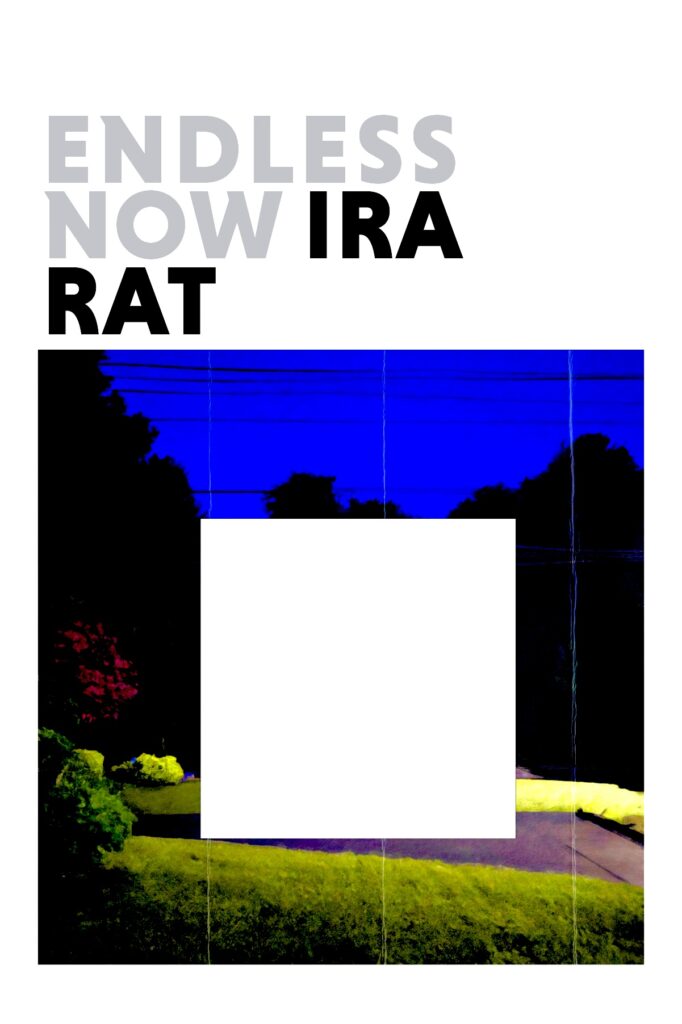
Endless Now
Ira Rat
IEndless Now is the latest collection of poetry by Ira Rat (author, of The Medication and Bitter.)
Endless Now also contains Mango Cherry, Ira’s first one-act play to be published.

Continue Reading…
Article originally Published in the Spring 2026 Issue.