
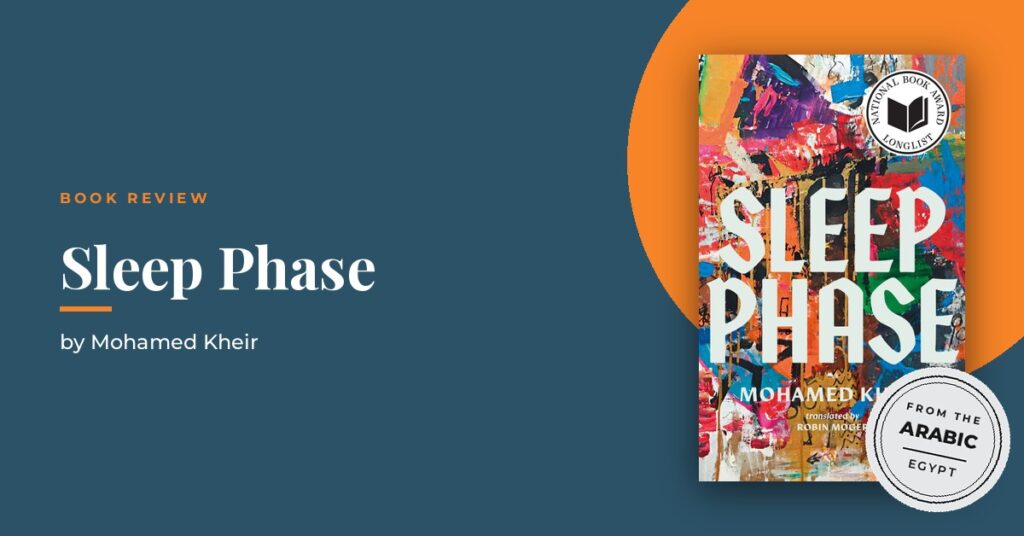
Sleep Phase by Mohamed Kheir, translated from the Arabic by Robin Moger
Fiction that wants you a little lost, on purpose.
Warif walks out of prison after seven years expecting, at minimum, to recognize the city he’s returning to. Instead he finds a Cairo rebuilt around him—bridges reassembled like footage played in reverse, expats and bureaucrats speaking in unplaceable accents, a translation job he can’t quite get back no matter how many official-looking strangers he meets with. Sleep Phase turns that disorientation into its entire method: the more Warif tries to reassemble a coherent picture of his own freedom, the more the novel itself starts to blur at the edges.
Kheir has a rare gift for describing hallucination and bureaucracy as though they’re the same genre of nightmare—which, in Warif’s case, they basically are. His meetings with faceless officials read like interrogations dressed up as small talk; his wanderings through the city curdle into something closer to fever dream, lush and vivid and not quite trustworthy. The novel never tells you where the real world ends and Warif’s imagination begins, and that refusal is the whole point—after seven years in a system built to erase him, why would he trust the difference either?
Robin Moger’s translation is where the novel’s real pleasure lives. Kheir’s prose has an almost tactile quality—bridges rebuilt lamp by lamp, a girl’s feet swinging over a river that seems to ripple in response to her—and Moger renders it with a patience that never rushes toward clarity the reader hasn’t earned. This is fiction that wants you a little lost, on purpose.
By the time Sleep Phase reaches its final pages, the line between what happened to Warif and what he’s decided to believe happened to him has become genuinely impossible to locate—and that’s exactly where Kheir wants you. This is a novel about the particular madness of being told, politely and repeatedly, that your own memory can’t be trusted, and it makes that madness feel as beautiful as it is suffocating.
This review originally appeared in the Fall 2026 Global Reads issue of Shelf Unbound, our free magazine celebrating the best indie and small press books.
Publisher: Two Lines Press