
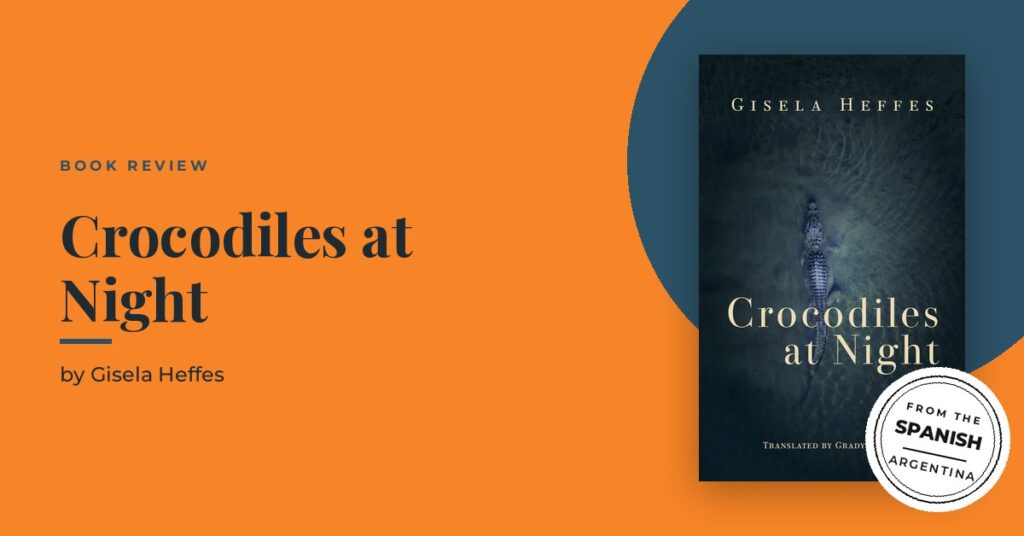
Crocodiles at Night by Gisela Heffes, translated from the Spanish by Grady C. Wray
Grief doesn’t just steal a person. It steals the calendar too.
There is a particular kind of vertigo that comes from watching a parent decline from four thousand miles away—the phone calls that arrive at the wrong hour, the guilt of a plane ticket you can’t always buy, the sense that your real life and your other life have started running on two different clocks. Crocodiles at Night, Gisela Heffes’s aching new novel, doesn’t just describe that vertigo—it puts you inside it, shuttling you between a house in Houston and a hospital in Buenos Aires until you, too, lose track of which day you’re in.
Heffes opens with a sleight of hand that sets the whole book vibrating: her narrator announces, in a notebook entry, that the woman at the center of this story isn’t really her—it’s an invented double named Vera Guerenstein. From there, the novel splits and layers itself: notebook entries, lived narration, fragments of correspondence between doctors and family members, all interwoven until fact and fiction stop behaving like separate categories. It sounds like a formal trick. In practice, it reads like the only honest way to tell a story this unbearable—as if inventing a little distance from yourself were the sole way to get close enough to write it down at all.
Heffes is a master of making form do the emotional heavy lifting. The novel begins by dutifully counting the days since her father’s surgery—Day One, Day Two—before time itself seems to give up and the count dissolves into a recurring, haunting label: “Day No Number.” It’s a small typographic gesture that says more about the disorientation of a sickbed vigil than pages of exposition ever could. Grief, this novel insists, doesn’t just steal a person—it steals the calendar too.
Some of the book’s sharpest, quietest fury is reserved for the machinery of care itself: a healthcare system fluent in euphemism, doctors who withhold the truth of a prognosis from the one person who most deserves to hear it, a family that builds, in Heffes’s chilling phrase, an entire “stage set” around a dying man so that he never has to know how the play ends. Anyone who has ever sat in a hospital corridor translating a doctor’s evasions into something like an answer will recognize this particular, infuriating fog immediately.
The prose itself is where this novel earns its keep. Grady C. Wray’s translation finds the exact English cadence for Heffes’s most devastating images—grief, at one point, is likened to spilling a glass of wine, a stain that “expands until it penetrates some remote space and stagnates there, like words.” That single sentence is worth the price of the book on its own—a reminder that Heffes thinks like a poet even when she’s writing her way through a hospital corridor.
This is not a novel that traffics in false comfort, and it doesn’t pretend the ending will surprise you—Heffes tells you as much in the opening pages. What she offers instead is rarer: a mirror precise enough that readers who have lived through a loss like this one will recognize their own reflection in it, and readers who haven’t will come away better prepared for the day they will. Slim, exacting, and unwilling to look away, Crocodiles at Night is the kind of book you finish in an afternoon and think about for months.
This review originally appeared in the Fall 2026 Global Reads issue of Shelf Unbound, our free magazine celebrating the best indie and small press books.
Publisher: Deep Vellum