
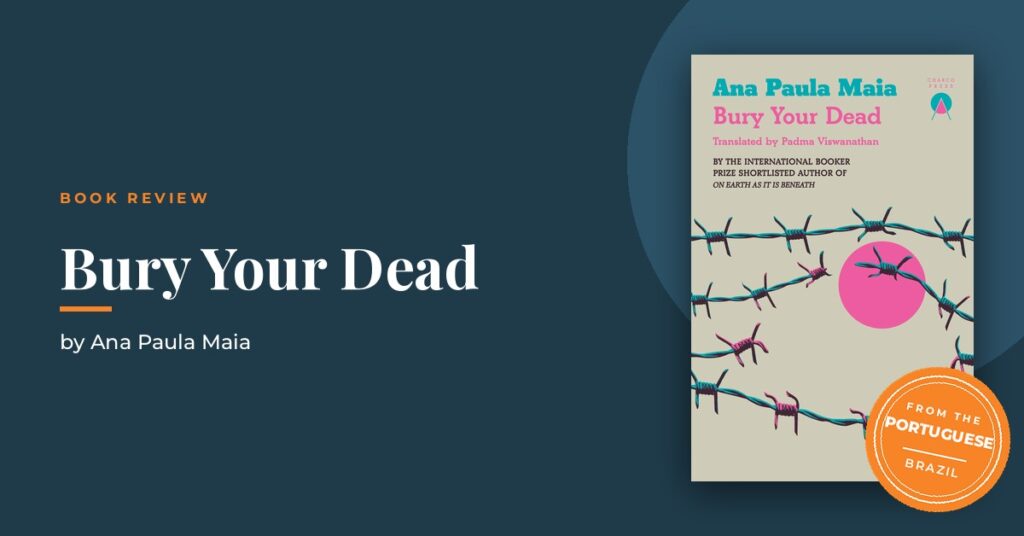
Bury Your Dead by Ana Paula Maia, translated from the Portuguese by Padma Viswanathan
The horror isn’t the body in the tree. It’s how unsurprised everyone is.
Edgar Wilson used to stun cattle for a living. Now he collects what the roads leave behind—the deer, the dogs, the occasional cow that wandered too far—and hauls the bodies to a mill where they’re ground into fertilizer. It’s steady work, and it asks very little of him emotionally, which is presumably the point. Then the vultures lead him to a woman’s body hanging from a tree, and Bury Your Dead stops being a novel about roadkill and becomes something much harder to look away from.
Ana Paula Maia writes in short, hard sentences that refuse to editorialize, which somehow makes the material more disturbing, not less. There’s no police force equipped to process what Edgar Wilson has found, no hospital system built to receive it—the machinery of the state simply isn’t designed for a body that falls outside its categories, and Maia lets that institutional blankness sit there, unresolved, doing its own quiet damage. The horror here isn’t the body in the tree. It’s how unsurprised everyone is that no one knows what to do about it.
This is Maia’s territory—she’s spent a career finding the exact seam where animal and human stop being separate categories, where slaughter becomes labor becomes routine becomes something almost sacred in its repetition. Bury Your Dead pushes that project further than ever: Edgar Wilson doesn’t perform some late-breaking moral awakening when he finds the woman’s body. He does what he knows how to do, because it’s the only language of care this world has left him.
Padma Viswanathan’s translation keeps the prose as spare and economical as a job description, which is exactly right—this is a book that trusts silence to do the heavy lifting. At just over a hundred pages, Bury Your Dead doesn’t waste a sentence, and it will stay with you exactly as long as its length suggests it shouldn’t.
This review originally appeared in the Fall 2026 Global Reads issue of Shelf Unbound, our free magazine celebrating the best indie and small press books.
Publisher: Charco Press