
We Were Forbidden by Jacqueline Harpman, translated from the French by Ros Schwartz
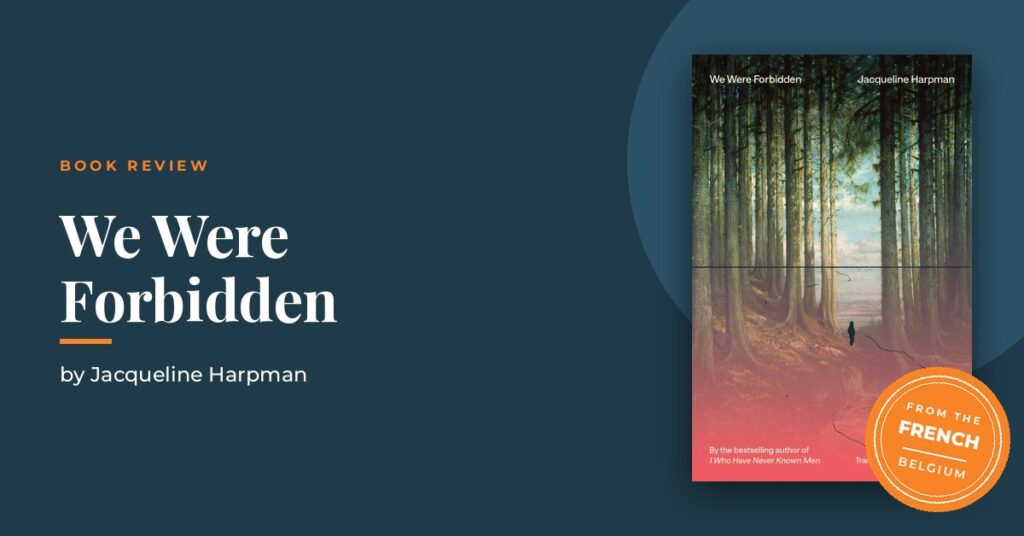
Like finding out your favorite writer had a secret second act.
Before there was I Who Have Never Known Men—the eerie, word-of-mouth phenomenon that turned a 1995 Belgian novel into one of the great sleeper hits of translated fiction—there was a writer quietly building an entire cosmology out of a single, dangerous question: what happens to a person who is told not to think? We Were Forbidden gathers three of Jacqueline Harpman’s novellas, none previously available in English, and together they read like a key to everything that made her famous in the first place—except funnier, stranger, and even more unsettling than you’d expect from the woman who wrote one of the bleakest, most beloved dystopias of the last thirty years.
Harpman knew a little something about being told what she couldn’t do. Born in Belgium, she fled with her Jewish family to Casablanca during the Nazi occupation, trained as a psychoanalyst after a stint in the Resistance, and spent decades writing before I Who Have Never Known Men found its English readership and made her, belatedly, a name. That biography isn’t incidental here—it’s the marrow of this collection. Every one of these three novellas is, at its core, a study of a person who has been handed a rule they didn’t write and is trying to decide whether obedience or defiance will cost them more.
The opener, “The Ardennes Forest,” will feel immediately familiar to anyone who loved I Who Have Never Known Men—a band of survivors, a war whose end (or existence) can no longer be confirmed, an order they are forbidden to question. But where the novel isolated its women in near-total silence, this story lets its soldiers argue, doubt, and rationalize their way through the eeriest kind of captivity: the kind with no visible walls. “We were living under the law of a world that might have disappeared: were we not mad?” one of them wonders—and that single sentence tells you everything about how Harpman builds dread out of nothing but uncertainty.
“The Outcast” moves from allegory into something closer to memoir, drawing on Harpman’s own adolescence at a rigid French school in wartime Casablanca. A girl commits one small, ordinary act of intellectual defiance—refusing to simply repeat what she’s told to believe—and watches the punishment for it ripple outward with a speed that still stings. It’s the quietest story in the book and, in some ways, the most devastating, a reminder that the machinery of enforced conformity doesn’t need tanks or prison walls. A classroom will do just fine.
Then, just when the collection threatens to become unrelentingly grim, Harpman pulls off her sharpest trick: she gets funny. “The Broom Closet” follows an aging novelist inventing a story to pass the time on a train—a bored bourgeois wife, a broom-closet affair, a marriage curdling toward fantasies of escape—and the narrator can’t stop interrupting her own creation to argue with it, flirt with it, and occasionally confess that she’s just as susceptible to its temptations as the woman she’s inventing. It’s the kind of story that makes you laugh out loud on one page and catch your breath on the next. Kirkus called the collection proof that Harpman belongs in the company of Gogol and Kafka, and “The Broom Closet” is the clearest evidence yet that she also belonged, whenever she wanted, in the company of the century’s great comic writers.
Ros Schwartz’s translation is the kind that disappears into the prose the way the best translations do—precise, unshowy, alert to every hairpin turn in Harpman’s sentences as they state a thing plainly and then quietly take it back. At just over a hundred pages, We Were Forbidden is small enough to read in an evening and dense enough to argue about for a week after. This is the rare backlist discovery that doesn’t feel like homework—it feels like finding out your favorite writer had a secret second act you didn’t know to wish for. Whether you arrive as a devotee of I Who Have Never Known Men or as someone meeting Harpman for the first time, this is the kind of introduction that turns readers into evangelists.
This review originally appeared in the Fall 2026 Global Reads issue of Shelf Unbound, our free magazine celebrating the best indie and small press books.
Publisher: Transit Books