
Author of Stone & Sky Trilogy
By Sarah Kloth
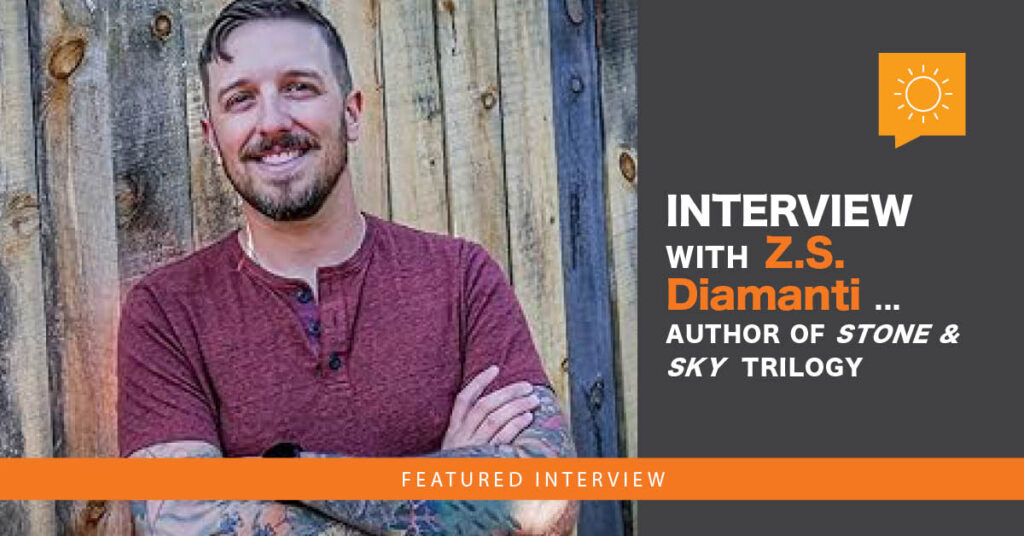
When you look back at the series now that it’s complete, what was the original spark that made you commit to this story in the first place?
ZSD: The biggest spark had to be when my wife read Stone & Sky. I had always been a creative, dabbling in music, illustration, comics, and more. She usually indulged my hobbies, but this was different. She read it, turned to me, and said, “You can do this.” The fact that she was also willing to–after a lot of family mathematics–let me quit my job and chase after this dream was a pretty big spark.
You’ve described Stone & Sky as classic, journey-driven epic fantasy. What aspects of that tradition were most important for you to preserve across all three books?
ZSD: What I remember loving about those old epic sword and sorcery books was that heroes had to band together to overcome seemingly insurmountable odds to save the world, but also that they had to accomplish this without losing what made them heroes to begin with. I had a constant alliteration running through my head: Honor, Heroes, and Hope at the end of the day.
The series uses multiple POVs across very different peoples and cultures. Why did this story require so many perspectives to be told honestly?
ZSD: The series as a whole pulls at the thread of hope to carry it through. Hope requires a gamble of trust, and this story required many gambles to build trust in order for the characters to save their world. This includes unexpected alliances with dangerous foes. Writing from multiple POVs gives you the opportunity to build trust between characters and readers to get them on board with taking a chance and seeing where a team up might go.
You chose to give goblins and orcs interior lives, families, and culture rather than treating them as faceless antagonists. What did that choice unlock for you as a storyteller?
ZSD: This was one of my favorite parts about writing the Stone & Sky series. It completely opened me up to the possibilities of the world of Finlestia. What if “the enemy” isn’t all bad? What if they’re just being led down a dark path by someone who was entrusted to lead them well? Better yet, what if the heroes among them were the everyday folk just trying to do the right thing by their family? Unlocking this gave me the opportunity to play in the sandbox and get really creative with different characters. Since the Stone & Sky series, I’ve even gotten to write a book where the main character is an anxiety-riddled goblin who goes on a fantasy road trip with a jovial halfling wagoner (Wagons & Wyverns 2025). I mean, how fun is that?
Readers often connect strongly with unexpected characters. Which reactions or favorite characters have surprised you most?
ZSD: Oh definitely. Because I unleashed “the enemies” and really got to dive into orc cities, cultures, and families, I get fans coming up to me at reader events all the time telling me how Karnak is their favorite. Really? A big bruiser of an orc who flies around on the back of a wyvern hurtling a flaming battle axe at his foes? You mean that guy? An orc husband and father just trying to lead the people of his city and do the right thing even if his king isn’t. Oh, yeah… That tracks. It’s a blast.
When building distinct cultures in the trilogy, what details mattered most in making them feel real rather than symbolic?
ZSD: On a big scale, I wanted to show some of the mundane moments in-between battles that really established each of the different people groups as just that: people. Enjoying conversation, or tea, or competition, or fellowship. These are all things people do. However, some tricks I used for realism had to do with language ticks. Doubling down on certain letters or sounds in speech for the different people groups makes them feel more like they’ve grown out of separate cultures inherently. For example, I use a lot of hard sounds and K’s and G’s for the orcs. While I like to use a lot of D’s or N’s for the dwarves.
Magic in this world is powerful but constrained. How did you design the magic system to create tension instead of easy solutions?
ZSD: To avoid any spoilers, I’ll say this: I had a plan for the magic system early on, but didn’t want it to be so constrained that I had to explain in great depth or essentially gamify the magic system in order for readers to enjoy the books. While the magic plays a pivotal role, the series is more about the story than the magic.
Aerial combat and flying companions are a defining feature of the series. How did your military and aviation background shape how you imagined the skies of this world?
ZSD: I grew up in the military (my dad was in the Air Force), and when I was old enough, I joined the military myself. I always had military aircraft flying around over my head. So, I thought, wouldn’t it be cool if there was a fantasy world where all the different fantasy races had their own flying “air forces” and we could have epic aerial battles? Yep! Sure would. Sure enough, that was actually what sparked the idea for the series. Then, of course, each culture and people having access to flying creatures and how those creatures lived and reacted would change the way the cultures would develop. I gave the humans griffins, the orcs wyverns, and the elves pegasi. Then created these black panthers with bat-like wings called garvawks, which are so savage that the dwarves have to put hunting parties together to go and capture them, using dwarven magic to turn them to stone, etching a rune on their shoulder, whispering a magic phrase in its ear, and then when it awakes, it is bonded with the new dwarven warrior. As you can see, everything really ramped up from there.
When writing large-scale action, especially in the air, what are you most focused on conveying to the reader?
ZSD: Grand epic battles have great weight and impact on the world around them. Of course. However, what makes battles interesting to me are the interpersonal battles. The fights within the battles. The parts where a griffin guardian does all he can to fend off an orc and wyvern duo who has just slain the guardian’s closest friend. What’s going through the guardian’s mind? How can he and his griffin fight this enemy and get to the rest of his unit to help them? Finding the personal stakes in the midst of the epic high stakes.
As the series progresses, the world expands and the stakes shift. How did your approach to worldbuilding change from the first book to the last?
ZSD: When you move through a series, you have more page time to unravel the depths of a world for the reader. If you try to do too much early on, you get pages and pages and even chapters of info dumping, and that’s not very fun for me. I like to get action moving along. In the Stone & Sky series, I expanded the world for readers by sending characters across the sea to find and explore the cultures of that land. So, over the span of a few books, you can really explore more and more of a world. Fun enough, I get to do that even now as my Fables of Finlestia series is set in the same world as Stone & Sky. In the Stone & Sky series, I got to expand more into the mysterious part of the world across the sea in Stone & Tide and got to expound more on the mythology of Finlestia in Stone & Ruin.
Villains in the series tend to feel layered rather than purely evil. What makes an antagonist compelling to you?
ZSD: I’m always excited to explore a villain’s motives. Are they filled with greed or power hungry because they have always been underestimated? Did they experience an unrecoverable loss that changes the trajectory of their lives? Are they just trying to ride the wave of destruction so they don’t get caught up in it?
Across the series, characters are often forced into cooperation before trust exists. Why is that dynamic so central to this story?
ZSD: One of the big themes of the series is hope for the future. Hope for something bigger or better than what the past had to offer. But that hope requires people coming together, standing together, and rising together. I’ve always found it fascinating how quickly people can overlook their differences and band together when the stakes are high and they have a common goal. I think it also just makes a lot of fun for interpersonal dynamics too.
You were intentional about building a foundation before publishing. How did that patience influence the reception of the series as a whole?
ZSD: I think having the patience to build a lot of the things I did before releasing the series gave me enough time to express to potential readers what I was hoping to achieve with the books. When I talked about all these amazing and fun fantasy series like Redwall, The Legend of Drizzt, Dragonlance, The Hobbit, and more, people were already getting a sense of what the feelings they would hopefully relive while enjoying the Stone & Sky series. Hopefully, they get a sense of nostalgia that brings them back to a time of wonder.
Now that readers have experienced the entire arc, what responses or interpretations have stayed with you?
ZSD: When I hear readers tell me that Stone & Sky is their favorite series, it blows my mind. I get families reaching out to me to share that they read the series every night before bed with their kids and they had an absolute blast. Oh, and that their son wants to see a griffin in real life now. To have men reach out to me and tell me they haven’t read a book series that made them feel this way in a long time, especially because they cried. Or even when someone tells me they hadn’t read a book since high school, but the series made them fall in love with reading. I’m getting misty-eyed even thinking about all these things.
Is there a type of scene you found yourself most drawn to writing across the series: intimate character moments, political tension, battles, or discovery?
ZSD: Honestly, I really enjoyed the range of scenes that writing an epic sword and sorcery affords. Interestingly, I did hear a lot about my more intimate settings, with people often telling me how cozy they were. As it turned out, I got to really lean into those cozy moments in the next series. But while I’m writing the fourth cozy fantasy in the Fables of Finlestia now, I am getting the strong itch for some epic battle scenes again. Scene variety is probably one of my favorite things about the writing process for big epic books.
Looking back, is there a risk you took in the series that you’re especially glad you didn’t soften or compromise?
ZSD: When I started writing the series, Game of Thrones and grimdark fantasy were the biggest kids on the block. But I wanted to write something that brought back nostalgia with honor, heroes, and hope. And I wanted to do it in a way I would be happy to share with my teenagers. Even though it might not have played into the popularity game, I can’t even count how many people have come to see me at events to tell me the series was an absolute breath of fresh air for them. For that, I am very grateful.
When readers finish the series, what do you hope lingers with them long after the last page?
ZSD: At the end of the day, I hope readers have an absolute blast with the Stone & Sky series. Bring on the nostalgia. Bring on the fun. Life can have some really tough challenges, and sometimes we just need a little fun to break through the darkness. And if readers look back on their time with the Stone & Sky series and the corner of their mouth ticks up at the feeling they had, that would bring me a lot of joy.
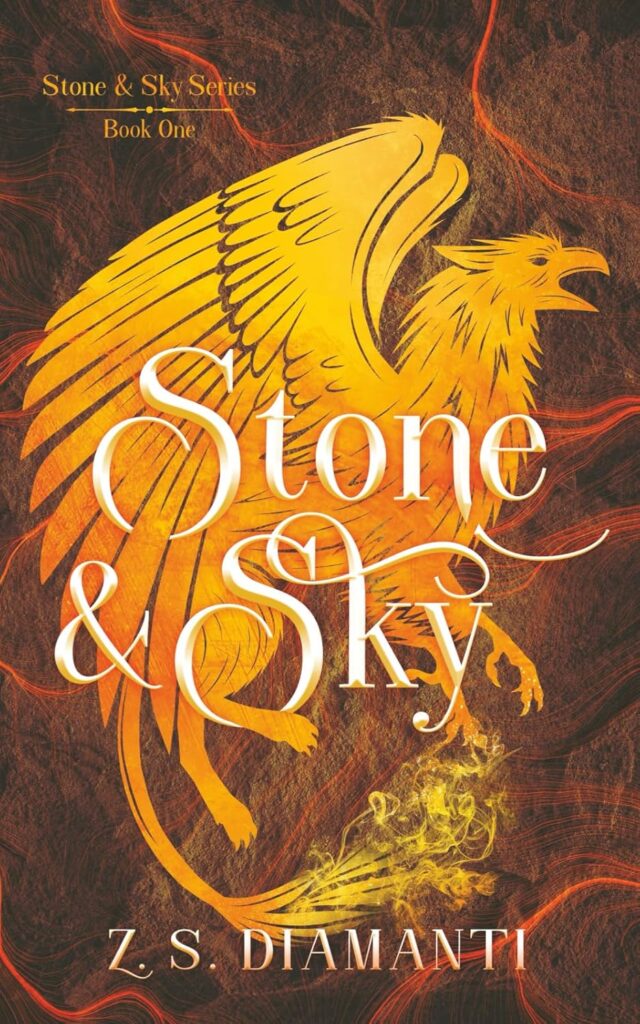
Stone & Sky
Z.S. Diamanti
Come fly away on griffin-back!
Fly off to the world of Finlestia in this epic fantasy story for readers looking for adventure, magic, and just plain fun; a tale where friendships must overcome insurmountable odds and remind readers to never lose hope. From across the sea, a shadow rises. A lone survivor may be the kingdom’s only hope against annihilation. Orin is a sworn protector. As a stalwart member of the Griffin Guard, he’s proud to protect the kingdom against a dreaded nation of orcs. But when the fires of war burn bright from the north, his entire squadron falls to deadly wyvern riders, leaving the devastated Orin bloody and alone. With his squad dead, Orin has his mind set on saving others from the same fate. Teaming up with a local huntsman’s family, Orin and his new friends must push themselves past their limits to face mysterious dangers and ancient magics. Shocked to discover the orcs’ secret weapon, the lone guardian’s last chance to save his home could require the ultimate sacrifice.

Continue Reading…
Article originally Published in the Spring 2026 Issue.